

While working in the online advertising industry, I came across the term “conversion rate (CVR),” which
You probably hear this phrase quite often.
However, there are actually quite a few people who do not fully understand its specific meaning, role, or how it is calculated.
So in this article, we’ll cover everything from the basic meaning of conversion rate to its importance and average figures,
Furthermore, we’ll provide a thorough explanation of specific improvement measures.
By using this information as a guide, you’ll be able to strategically leverage your CVR to run more effective online ad campaigns.
The Basics of Conversions (CV) and Conversion Rates (CVR)
The Meaning of "Conversion"
"Conversion" is a term that means "transition" or "transformation."
In the web industry, the main focus is on “Results Achieved Through the WebsiteIt is used as a term to refer to "", and is abbreviated as "CV."

The nature of these “results” varies depending on the website operator’s objectives.
For example, the following actions are typically set as conversions:
- Purchasing Products
- Request Information
- User Registration
In addition, each stage leading up to conversion (e.g., reaching the input form, displaying the confirmation screen, etc.)
「Micro-conversion (MCV)"It is also possible to track this and analyze user behavior in detail."
For example, in the case of a company’s own online store, the process generally follows the steps outlined below.
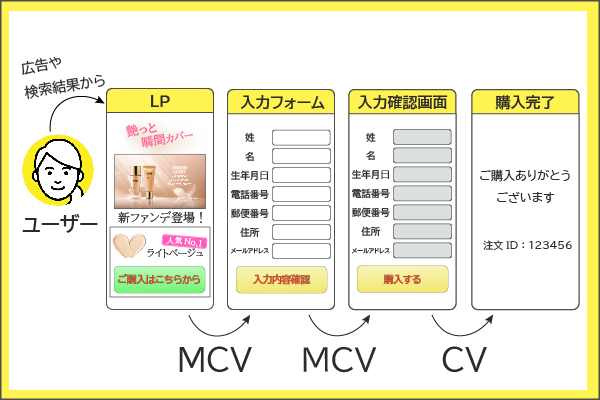
In this case, the final conversion is a “product purchase,” and
"Navigating to the input form page" and "navigating to the input confirmation page" are micro-conversions.
Meaning of Conversion Rate (CVR)
"Conversion Rate" refers to,
Among the users who visited the site,A metric that shows what percentage resulted in a conversionThat's it.
CVR plays an extremely important role in measuring the effectiveness of online advertising and marketing activities.
For example, it is used for the following purposes:
Site-Wide Performance Evaluation
Analysis of Specific Traffic Sources and Campaign Performance
Landing Page (LP) Optimization
How to Calculate Conversion Rates
The conversion rate is calculated using the following formula:
Conversion Rate (CVR) = Number of Conversions ÷ Number of Visits × 100
For example, if a page received 1,000 visits and generated 20 conversions, the CVR would be calculated as follows:
20 ÷ 1000 × 100 = 2%
However, if the definition of the "number of visits" used as the base figure differs (e.g., banner impressions or landing page visits),
Since CVR figures can fluctuate, caution is needed when making comparisons.
What is the average conversion rate?
The average conversion rate is largely influenced by the following three factors:
Industry and Product Type
Types of Inbound Keywords
Conversion Settings
Industry and Product Type
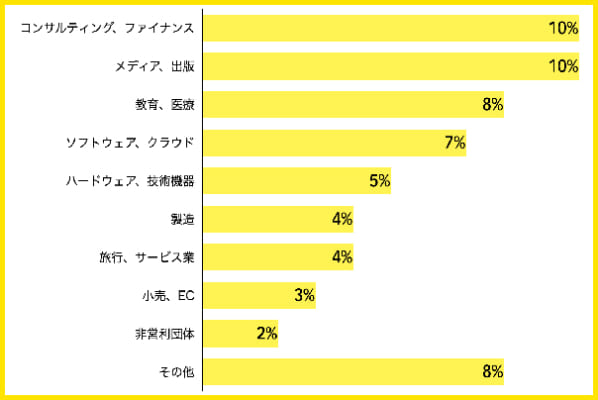
As you can see from this graph, the following trends are evident.
B2B industry (e.g., consulting services): The average conversion rate is around 10%.
B2C industries (e.g., retail and e-commerce sites): The average conversion rate is about 3%.
Furthermore, what we can see from this is that,The higher the unit price per product, the higher the average conversion rate.That's the point.
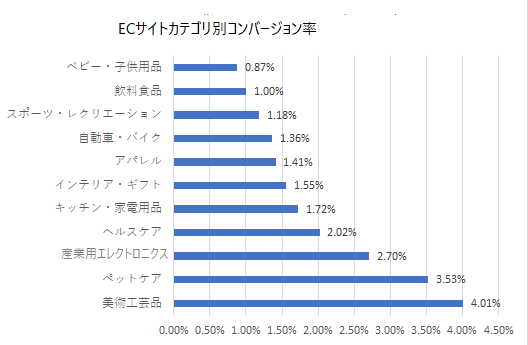
In addition, there are significant differences depending on product category; while arts and crafts have an average CVR of 4.01%,
There is a wide range in baby products, such as 0.87%.
The average also varies by product categoryYou can see that, can't you?
Types of Inbound Keywords
If you're primarily using paid search ads to attract customers,The conversion rate also varies depending on the type of keywords you bid on.
① Navigational keywords (e.g., “Amazon,” “Instagram login”)
Since users are searching with a specific purpose in mind, the average CVR tends to be high, at around 10%.
Since users search for specific products or services with a specific purpose in mind, the average conversion rate tends to be higher.
② Transaction-based keywords (e.g., “table online shopping,” “Illustrator download”)
Many users are in the comparison and consideration stage, and the average conversion rate is around 2%.
Users are looking for the products and services they want, and they are “comparing and evaluating” them in order to choose the best ones from among the many available options.
It’s important to note here that transactional keywords do not necessarily mean users have already decided they want a specific product or service.
Since this is the stage where users are comparing and evaluating options within a specific category, the average conversion rate is lower than that of navigational keywords.
③ Informational keywords (e.g., “advertising effectiveness measurement methods,” “recipe for yellowtail and daikon radish”)
Purchasing intent is low, and the average conversion rate (CVR) tends to be low, at around 1%.
Since users are simply “curious,” this rarely leads to purchases, so the average conversion rate isn’t particularly high.
Differences in Conversion Settings
When "Purchase" is set as the conversion, the average CVR is typically between 0 and 31 TP3T, but
When “Request a Free Sample” or “Request Information” are treated as conversions, the conversion rate can sometimes reach 10% or higher.
3 Strategies to Boost Conversion Rates
1. Landing Page Optimization (LPO)

Designing an effective landing page (LP) is key to improving the conversion rate (CVR).
・Creating content that clearly communicates the benefits of products and services
・UI design that allows users to fill out forms without stress
・Designing user flows that smoothly guide users toward conversion
2. Highly Accurate Targeting

When serving ads, it is important to clearly distinguish between the following user segments.
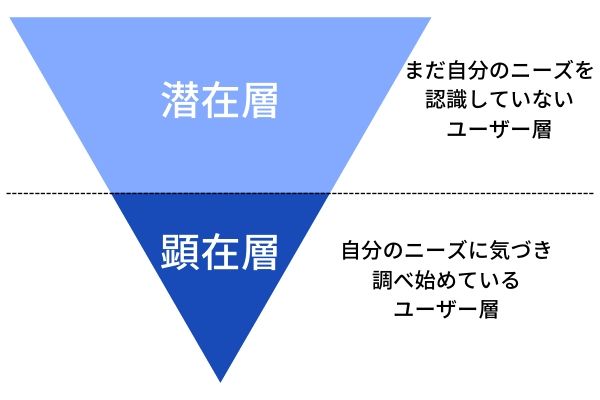
Among these, the group with the highest percentage of people most interested in the product is"The Visible Layer"That's it.
By prioritizing targeting the visible segment,CVR will improve。
However, a strategic distribution plan that takes the latent audience into account will prevent lost opportunities.
We need to be careful not to overlook “potential buyers” who may be in the latent segment.
3. Lower the conversion barrier

By changing the conversion type from “Purchase” to “Request a Free Sample” or “Request Information,”
There is a possibility that the CVR will improve significantly.
However, it is important to simultaneously implement measures to encourage purchases after a free conversion (e.g., follow-up emails and coupon distribution).
Don't get too caught up in conversion rates alone

CVR is certainly an important metric, but,The ultimate goal is overall sales and profitsDon't forget that.
For example, focusing too much on the conversion rate (CVR) could result in a decline in average revenue per customer or have a negative impact on long-term profits.
In addition to CVR, I think it’s a good idea to keep the following metrics in mind as well.
Return on Advertising Spend (ROAS)
Customer Lifetime Value (LTV)
Total Sales and Profit
Summary
In this article, we’ve provided a detailed explanation of conversion rates—from the basics to how they’re calculated, average values, and strategies for improvement.
To improve the conversion rate (CVR), specific measures and ongoing evaluation are essential.
However, CVR is just one factor in increasing sales.
Let’s move forward with our operations while keeping our overall goals in mind and following a comprehensive strategy.