


I’m sure there are many people who aren’t quite sure how to calculate LTV, aren’t there?
And that makes sense, since the way LTV is calculated varies depending on the sales approach and the target audience.
In this article, we’ll focus specifically on “subscription-based e-commerce (single-item repeat purchases)” in the e-commerce industry, covering everything from how to calculate LTV to strategies for increasing LTV in subscription-based e-commerce.
What is LTV (Lifetime Value)?
If you're new to the e-commerce industry, you need to thoroughly understand what LTV is before learning how to calculate it.
If you're absolutely sure you've got this covered, please skip ahead to "How to Calculate LTV in E-commerce" in the table of contents.
The True Meaning of LTV

"LTV" is an acronym for "Lifetime Value," and"Customer Lifetime Value"It translates as...
To put it simply,"The total amount a customer has paid for a specific product or service over their lifetime"That's what it means.
If people like a product, they'll buy it more than once.
As consumers, we often find ourselves buying the same products over and over again, don't we?
For example, you might like the scent of a certain cosmetic product, or you might buy something because it suits your skin even though it’s a little more expensive than other products—there are various reasons for making a purchase, butI often buy the same product againThat's right.
However,If a customer switches to a competitor's product, revenue from that customer stops at that point.
So, the key to increasing sales is ensuring that customers don't leave and encouraging them to make repeat purchases, right?
That’s why LTV is essential as a metric for measuring whether repeat purchase rates are increasing and sales are rising.
Aren't you going to set a fixed period?
As mentioned above, LTV refers to “the total amount a customer has paid over their lifetime,” butGenerally, we tend to set a specific time frame.。
Depending on how products or services are sold, the LTV period can vary—ranging from one year to two years, for example—but,Generally speaking,"One Year"is calculated as follows。
The reason for setting a timeframe is that it allows you to create a business plan—for example, “This project will reach the break-even point in its second year, and revenue over the two-year period will be X”—and to calculate the necessary advertising costs.
How to Calculate LTV in E-commerce
The Basic Formula for Calculating LTV
Even if you search for “LTV calculation method,” all you get is"LTV = Average Order Value × Average Purchase Frequency × Average Purchase Period"I think there are a lot of equations like this.
To be honest, I bet there are quite a few people who find it hard to calculate and don’t really understand it, right?
So, here is a basic formula that generally applies to almost every industry.

This is the simplest formula for calculating the LTV per customer.
Since almost every business calculates its monthly and annual sales and the number of customers, it’s easy to plug those values into the formula above, isn’t it?
Two Methods for Calculating LTV in Subscription-Based E-Commerce
However,In the case of subscription-based sales (single-item repeat orders), things get a little more complicated.
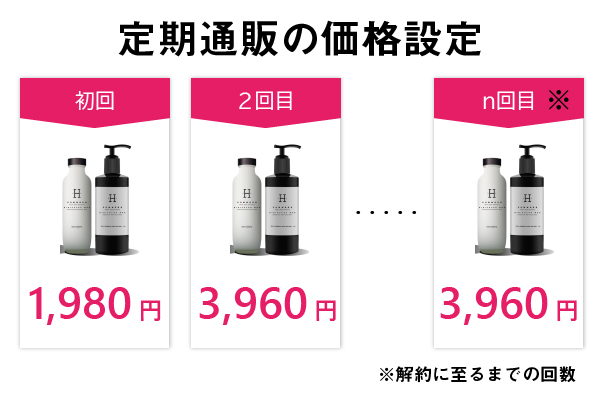
This is because, with subscription services,The price for the first purchase is often different from the price for subsequent purchases.That's why.
And thenWe gain new customers every month.
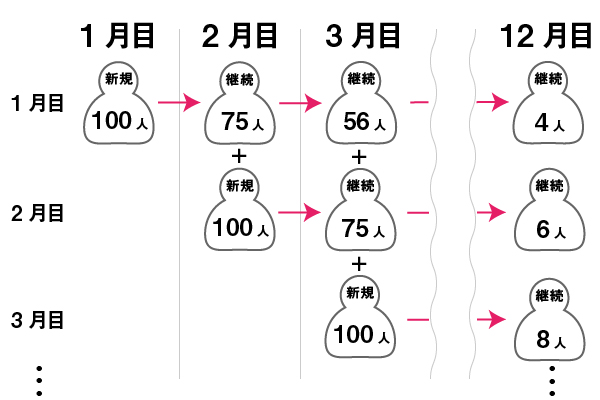
If you calculate LTV here using “total sales for the year ÷ number of customers,” the result will inevitably be lower because that figure includes new customers who started making purchases between the second and twelfth months, as well as their sales.
In other wordsRevenue from new customers in months 2 through 12 is,Do not include this in the calculation.
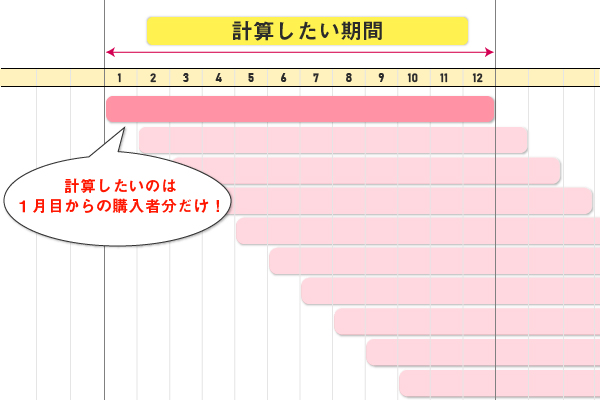
(Later, I’ll also show you how much lower the LTV becomes when the calculation mistakenly includes new customers from months 2 through 12.)
In conclusion, here’s how to calculate the “LTV per product” for recurring subscription services (single-item repeat purchases).
"LTV = (Initial unit price × Number of purchases in the first month + Unit price for purchases 2–n × Number of customers who made purchases 2–n times out of those who purchased in the first month) ÷ Number of customers who purchased in the first month"
(For the "2–n times" part, please substitute the number of product shipments for the period you wish to calculate.)
Since we're calculating for one year this time, we'll set n to 12.
*Assumes monthly shipping.
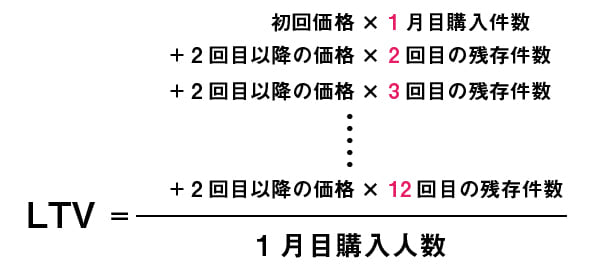
In this case, the “number of remaining cases” is calculated based on the repeat rate.
If you don’t have the original data—for example, when estimating the LTV of a new product—use the repeat purchase rates of existing or similar products as a reference.
As an example, let's calculate the LTV under the following conditions.
・1,980 yen for the first session; 3,960 yen for the second session and beyond
・Industry-average repeat customer rate: 75%
・Aim to acquire 1,500 new customers every month
・Ship one item per month
Applying this formula,
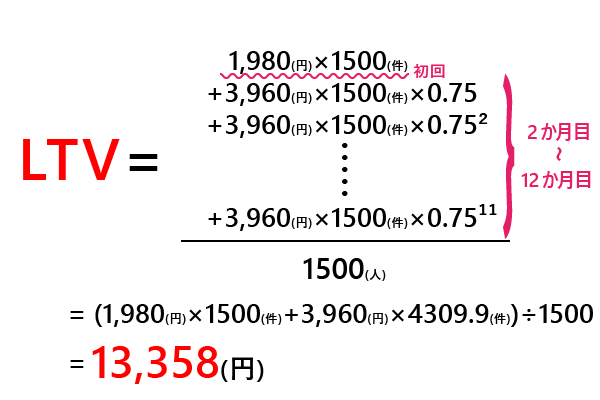
I was asked to calculate the one-year LTV for customers who made their first purchase in January.
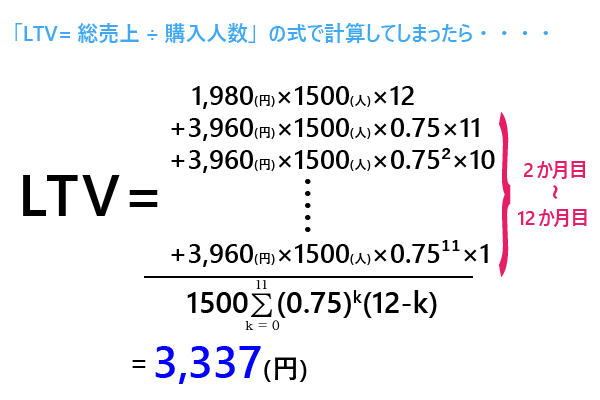
Next, I’ll show you what happens if you mistakenly calculate LTV using the formula “LTV = Total Revenue ÷ Number of Customers.”
In this case, since the LTV includes new customers acquired between the 2nd and 12th months, it is quite low.
The maximum CPA can be calculated based on LTV
In addition, based on the calculated LTV,Marginal CPAYou can request it.
What Is Marginal CPA?"The maximum amount you can spend to acquire new customers for recurring products"So, if we go over this amount, we'll be in the red.
The marginal CPA is calculated using the following formula.

For example, assuming a gross profit margin of 40%, when the LTV is 24,000 yen,
24,000 yen × 0.40 = 9,600 yen (marginal CPA).
5 Strategies for Increasing LTV in Subscription-Based E-Commerce
As mentioned above, here is the formula for LTV in recurring subscription sales (single-item repeat sales).
"LTV = (Initial unit price × Number of purchases in the first month + Unit price for purchases 2–n × Number of customers who made purchases 2–n times out of those who purchased in the first month) ÷ Number of customers who purchased in the first month"
In other words, by optimizing the values in this formula, you can increase LTV.
Increase the unit price of products
First, the first measure is"Raise the unit price"That is the point.
Since the unit price for the first purchase often differs from that for subsequent purchases in subscription-based products, you should carefully decide which price to raise—taking into account the pros and cons in terms of customer acquisition.
Increase the repeat rate
Second is"Increasing the Repeat Purchase Rate"That is the point.
If the repeat rate increases, the number of retained customers will increase.
From a mathematical perspective, while the number of first-month purchasers—the denominator—remains the same, the numerator—"the number of first-month purchasers who remain active through their 2nd to nth purchases"—increases, causing the LTV to rise.
As for ways to increase the repeat purchase rate, there are various strategies to consider.
For exampleIncluding next month's coupon in the package to boost sales, or、Sending automated email sequences to maximize customer satisfaction, orThis is also one of the measures.
Increase the number of items shipped
The third one is"Increase the Number of Shipments"That is the point.
For example, let's say we ship two items every two months starting with the second shipment.
Therefore, the number of units shipped in the second month is “Number of customers in the first month (= Number of units shipped in the first month) × Repeat purchase rate × 2.”
If we calculate and add the figures for the 4th and 6th months in the same way, we find that—even though the repeat purchase rate is the same as that of first-month buyers—the number of first-month buyers who remain active through their 2nd to nth purchases is higher than when shipping one item per month.
Reduce the cost of acquiring new customers
"LTV = Average Order Value × Average Purchase Frequency × Average Purchase Period – (Customer Acquisition Cost + Customer Retention Cost)"
This formula is also commonly used to calculate LTV.
Based on this equation,"Reducing the Cost of Acquiring New Customers"This is also one of the strategies for increasing LTV.
If you can improve ad quality and lower CPA, LTV will increase.
Reduce customer retention costs
Similarly"Reducing Customer Retention Costs"This is also one of the measures.
For example, the third point I mentioned—"increasing the number of shipments"—also helps reduce customer retention costs.
That's because we ship two items at a time, which reduces shipping costs.
In addition, cutting “call center costs” and “SG&A expenses” will likely increase LTV.
However, this"Reducing customer retention costs" isA double-edged sword...as well.
For example, “increasing the number of items shipped” might dampen prospective customers’ desire to buy, leading to a decline in the number of sales.
Similarly, “cutting call center costs and SG&A expenses” could lead to a decline in service quality, which in turn could lower customer satisfaction and ultimately result in a drop in repeat business rates.
As such,While “reducing customer retention costs” is important, it may not lead to increased sales.
Ultimately, the key to increasing LTV isOne means of achieving the ultimate goal of “profit maximization”Let's not forget that.
Summary
In this article, we provided a detailed explanation of how to calculate and increase LTV for subscription-based e-commerce (single-item repeat purchases).
I hope you now understand that the method for calculating LTV varies depending on the “sales approach” and the “type of LTV you’re looking for.”
However, as long as you keep the original formula—"LTV = Total Revenue ÷ Number of Customers"—in mind, you should be able to derive the LTV formula yourself, regardless of the sales method you use.
We were also able to figure out how to increase LTV based on the formula, weren't we?
To identify areas for improvement in your subscription service, try calculating the LTV of your products.