

There are a lot of similar terms in the online advertising industry, aren’t there? Among them, “CPM” is one you hear quite often.
These are terms commonly used in day-to-day industry operations, but do you fully understand them?
"CPM" is a term you must understand when developing an advertising strategy.
So in this article, we’ll take a detailed look at CPM—from its meaning to the contexts in which it’s used, as well as similar terms.
What is CPM?
First, what is CPM (cost per mille)?Cost Per Mille (CPM)is an abbreviation for “Cost Per Impression" is the translation.
The ”M” in CPM stands for ”M,” the Roman numeral for 1,000.
Alternatively, it comes from the Latin word ”Mille,” which means 1,000.
*Also known as: CPT (Cost Per Thousand Impressions)
Please note that this is different from the English unit of distance, the "mile."
CPM as an “Analytical Metric”
There are two ways to use CPM; the first is"The advertising cost per 1,000 ad impressions"In that sense, it is primarily used to analyze the return on advertising investment.
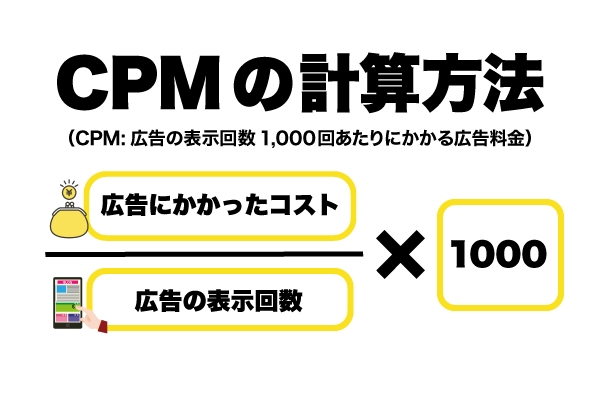
For example, if you had 1 million impressions at a cost of 500,000 yen,
"500,000 yen ÷ 1,000,000 × 1,000 = 50 yen (CPM)"
The CPM rate is50 yen for every 1,000 viewsThat's how it works.
Furthermore, when using CPM as a metric, the term “eCPM (effective CPM)” is often used.
This is used to identify the appropriate CPM range within the target CPA, as this range varies depending on the media used, the product category, and the delivery settings during a campaign.
CPM as an “Advertising Billing Model”
The second one is “CPM Billing (Per-Impression Billing)"This is when it is used as an advertising revenue model."
CPM billing refers to a "billing system in which advertising fees are charged whenever an ad is displayed." While online advertising primarily consists of CPC and CPM billing models, LINE Ads and TikTok Ads, for example, are examples of CPM-based platforms.
By the way, CPM rates vary depending on the product category and targeting.
Differences from CPC
There's also a similar term called "CPC," isn't there?
It stands for Cost Per Click and is translated as “cost per click.”
In this post, I’d like to discuss the differences between “CPM” and “CPC,” two terms related to CPM.
First, let's review what CPC means.
CPC as an "Analytical Metric"
There are two ways to use CPC. First, the first one isCost per clickThat's what it means.
▼Calculation Method
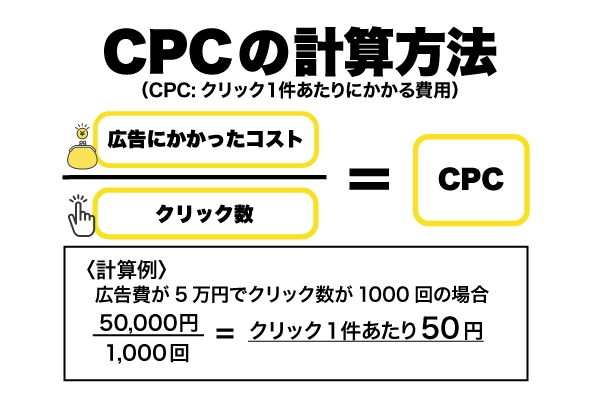
Based on the calculation example shown above,The fact that it cost 50 yen per click in advertising feeswill be.
CPC as an “Advertising Billing Model”
And the second one is “CPC Billing (Pay-Per-Click)"This is when it is used as an advertising revenue model."
CPC billing refers to a "billing system in which advertising fees are charged when an ad is clicked," and search ads are the primary type of advertising that falls under this CPC billing model.
The Difference Between CPM and CPC Billing
Now that we’ve reviewed the meaning of CPC, let’s summarize the differences between CPM and CPC in the context of mobile advertising billing.
To summarize when charges are applied, here is a breakdown:
CPM Billing: Charges are incurred when an ad is displayed 1,000 times
CPC Billing: Charged when an ad is clicked
With CPM billing, you are automatically charged once 1,000 impressions are reached, whereas with CPC billing, you are charged per click, so you will not be charged unless the ad is clicked.
Next, we’ll explain the pros and cons of CPM billing in greater detail.
Benefits of CPM Billing
First, let’s discuss the benefits of CPM billing.
The higher the CTR, the lower the cost per click.
With CPM billing, a charge is incurred every 1,000 ad impressions, so the cost remains the same whether there are 10 or 100 clicks.
In other words,Ads with more clicks have a lower cost per click.That's the point.
To give a specific example, suppose we ran ads A and B with the same settings, spending 10,000 yen on each, and the results were as shown in the table below:
| Ad A | Ad B | |
| Streaming Costs | 10,000 yen | 10,000 yen |
| Number of views | 10,000 times | 10,000 times |
| Number of clicks | 100 times | 200 times |
| CTR | 1.0% | 2.0% |
| CPC | 100 yen | 50 yen |
| CPM | 1,000 yen | 1,000 yen |
Although both have the same CPM of 1,000 yen, Ad B, which has a higher CTR, has a lower CPC than Ad A.
As such, with CPM billing, the higher the CTR, the lower the CPC, so it’s crucial to know how to create ads with a high CTR.
However, it’s not uncommon for a high CTR to actually lead to a lower CVR and a spike in CPA, so be careful when optimizing for CPA.
Since it's a flat fee, advertising costs can be kept down
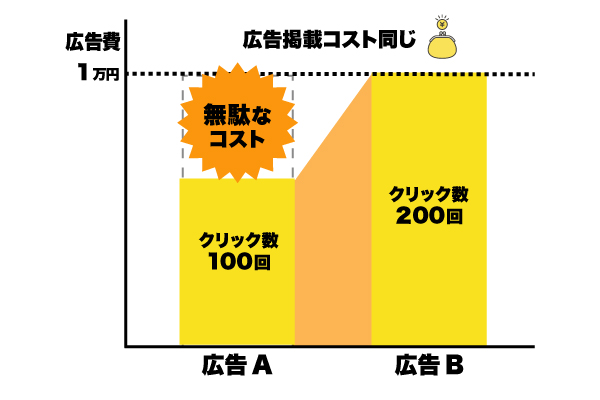
Since the cost is calculated based on the number of times an ad is displayed on the web, the cost of running the ad remains the same regardless of how many times it is clicked.
For that reason, for the purpose of PR and other activities,If ad impressions are maximized, the return on investment will be high.。
It makes it easier to control your advertising budget
As mentioned earlier, with CPM billing, advertising costs are determined by the number of times an ad is displayed, regardless of the number of clicks.
On the other hand, with CPC billing, advertising costs are determined by the number of clicks. As a result, if the ad becomes a hot topic on external advertising platforms or social media and the number of clicks increases, the bill can skyrocket...
With CPM billing, that doesn't happen.
Since advertising costs remain constant, it's easy to plan your monthly budget.
Disadvantages of CPM
Advertising costs are incurred even if users don't click on the ads
The fact that you’re charged whenever an ad is displayed on the web means that, conversely, even if it doesn’t lead to user actions (such as clicks or conversions),Advertising costs are involved.
Therefore, if your goal is to drive conversions, focus on increasing your click-through rate.
There are risks in terms of cost-effectiveness
If your sole goal is to maximize impressions so that as many people as possible see your ads, this is the ideal payment model; however, it carries risks if your goal is to drive conversions.
This is because the ads aren't optimized for potential customers who are likely to convert on the landing page.
Since ads are not targeted exclusively at prospective customers but are also shown to other users, there is a risk of incurring unnecessary costs.
If you'd like to learn more about the pros and cons of CPC billing, please check out the article below.
Summary
That concludes our explanation of “CPM.”
When it comes to understanding digital advertising, CPM is a key metric that cannot be ignored.
Mastering the basics of ad management and selecting the billing method that best suits your company’s marketing strategy is the fastest route to success.
Be sure to put this explanation to good use in your future advertising strategies!