


Ad networks, often abbreviated as “Adne” in the industry.
In this article, we’ll explain how ad networks work and discuss their pros and cons.
"What is an ad network?"
"How does it actually work?"
If you have questions like these, please take a look.
Keywords
Before we get into the main topic, I’d like to introduce some important keywords that appear frequently in this article.
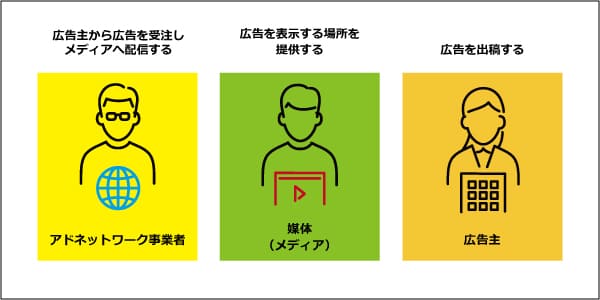
Ad Network: I'll explain this later.
Media: Websites and other platforms where ads are served
Advertiser: People and businesses that place and distribute ads
Ad Network
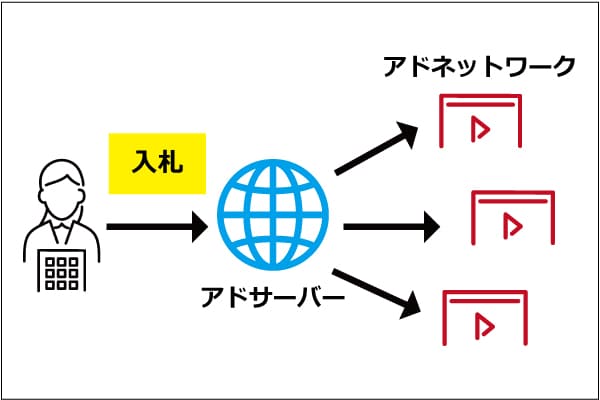
An ad network is a platform that brings together multiple web media outlets (such as websites, social media, and blogs) toA system that creates an ad distribution network and delivers ads to those media outlets in a consolidated mannerThat's it.

Ad networks first appeared around 2008, andAdvertisers are freed from the hassle of placing ads on each individual media outlet, enabling efficient ad delivery.It has become.
Before that, in order to place ads in various media outlets, we had to contact each one individually to check rates and availability, and then submit the ad copy.
(Ads served on ad slots for which a direct contract has been signed in this manner are referred to as “Sponsored Ads" he says.)
When running online ads, it’s more effective to run them on multiple platforms at the same time, isn’t it?
However, until ad networks emerged, advertisers
・It takes a lot of effort to select media and place ads
・To secure ad space, we have to submit a large number of ad placement requests to each media outlet
・Since the data provided by each media outlet differs even after the ad campaign ends, it is difficult to compare them.
・Advertising must be managed separately for each media platform
There was a problem like this.

On the other hand, the media...
・You must conduct sales activities and negotiations with advertisers
・We must report results to advertisers
・Unless a media outlet has a certain amount of content, it is difficult for it to be attractive as an advertising space.
There were problems like that, too.
The solution to all these problems was “Ad Network"."
"Ad networks"—Advertising Network” to "Bid”By serving ads in this format, advertisers can now deliver their ads to a large number of websites all at once.
Introducing Ad Network Providers
Currently, there are numerous ad network providers, but in this article, we’ll introduce some of the most commonly used ones.
Google Display Network
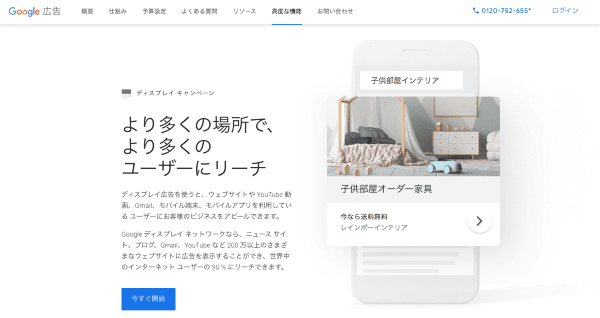
You can display ads on over 2 million different websites, including news sites, blogs, Gmail, and YouTube, reaching 90 % of Internet users worldwide.
>>If you'd like to learn more about GDN, please read the article below.
Yahoo! Display Network
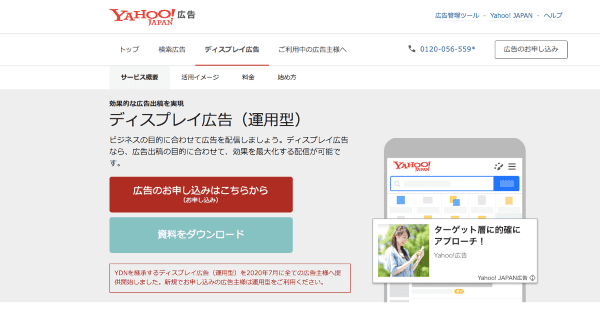
You can serve ads on sites operated by Yahoo! (such as Yahoo! Weather and Yahoo! Chiebukuro) and partner sites (such as msn and Tabelog).
※ https://promotionalads.yahoo.co.jp/service/displayads/
popIn
This is a content distribution service developed with the goal of enhancing and demonstrating the value of web media.
In addition to improving user engagement on the site, we currently have the platform implemented by more than 900 web media outlets—including major newspapers, publishers, and news agencies—for purposes such as content and user analysis, as well as monetization through advertising.

※ https://www.popin.cc/home/index.html
AKaNe by GMO
Since ads are displayed in an in-feed format, this platform is ideal for delivering content ads, where it is crucial that the content is actually read.

Advantages and Disadvantages for Advertisers
How has the introduction of ad networks changed the way advertisers deliver ads? We’ll take a look at the pros and cons.
Benefits
Makes ad delivery easy

Advertising distribution used to involve not only different billing structures and submission guidelines for each media outlet, but also a time-consuming process from media selection to ad placement.
With the introduction of the ad network,You can place a large volume of ads simply by submitting your files and placing bidsIt has turned out this way.
Thanks to that,The burden on advertisers has been significantly reduced,That’s why it’s now easy to stream.
See the results after your ad campaign goes live

Impressions, Clicks, Click-Through Rate, Conversions, Conversion Ratesuch asWe are now able to obtain performance measurement dataAs a result, we are now able to manage our advertising campaigns more efficiently.
Disadvantages
Using multiple ad network providers can make management complicated
Since ad slots on ad networks tend to be concentrated in a single category, if you want to run ads across multiple categories, you’ll need to place ads on multiple ad networks.
In this case,Since billing structures and performance measurement methods vary by ad network, management often becomes difficult.That's it.
Additionally, if you run Ad Network A and Ad Network B simultaneously and ads are served on the same media outlet, the performance of each ad may decline.
Be careful not to run duplicate ads, as this not only wastes advertising budget and annoys your target audience but can also damage the image of your product, brand, or company.
It is difficult to determine where the ads are being displayed
Since I generally can't choose which sites my content appears on,Ads being placed on non-target sitesThere is.
Since ad performance could potentially decline, a mechanism has also been implemented to prevent ads from being displayed on certain sites.
Benefits for Media Outlets
There are benefits for the media as well.
Reduced Time and Effort
Although sales activities and detailed negotiations with advertisers were necessary, ad network operators began handling the sales themselves.
Also, since the ad network provider tracks everything, including the number of clicks,Significant reduction in the media's effort and timeIt was done.
Multiple ads can be displayed in a single ad slot
You can now display multiple ads in a single ad slot, allowing you to make effective use of the ad slot.
Related Terms
Another thing to keep in mind along with ad networks is"DSP"That's it.
Although these two are often confused, their functions and roles are different.
"DSP" stands for Demand-Side Platform, andAn automated optimization tool designed to improve the return on investment for ad campaignsThat's it.
Advertisers register their budget, website information, target audience, target CPA, banner creatives, and other details, and the system automatically purchases and delivers ad space on the internet based on that information.

So, some of the banner ads you see on a daily basis are actually being displayed as a result of optimization by tools like DSPs.
To summarize,An ad network is an "advertising network" that brings together multiple websites.In contrast, A DSP is an "automation tool" for delivering ads to various ad networks.That's it.

"I just want to distribute it widely and in large quantities."In such cases, an ad network is a good fit, and
"I want to target specific people and reduce the effort involved in managing them."In that case, a DSP would be the best choice.
Weaknesses of Ad Networks
While ad networks can reach a wide and diverse audience, some of the potential customers they target have low affinity with the brand, and ads are still being served to those users.
Therefore, “retargeting” is often used in conjunction with ad networks to further improve their performance.
If you'd like to learn more about "retargeting," please read the article below.
By utilizing retargeting, you can focus your ad delivery on users who are relatively likely to be interested in your content.
Since this enhances overall advertising effectiveness, it should generally be set up as a matter of course during campaign management.
Summary

With the advent of ad networks and DSPs, the burden on ad publishers has been significantly reduced.
Now that the burden has been reduced, advertisers will want to produce higher-quality ads.