

For those of you thinking about listing products on Amazon,
"How much are Amazon's listing fees?"
"Are the fees higher than at other malls?"
There are so many questions like that, aren't there?
In this article, we’ll provide a detailed explanation of Amazon’s fees, covering everything from how they vary by seller account type to comparisons with online marketplaces other than Amazon.
Please read this article to choose the e-commerce site that's right for you, including Amazon, Rakuten, and Yahoo! Shopping.
Details on Amazon Fees
Amazon fees are generally categorized into three types: monthly listing fees, sales commissions, and FBA fees.
"Listing Plans"
"Product Categories We Sell"
"Whether or Not You Use FBA"
It depends on .
Monthly Listing Fee

When selling on Amazon, you’ll need to choose between two plans: “Professional” and “Individual.”
If you sell more than 50 items per month, be sure to select the “High-Volume Seller” option.
Even if you don't reach 50 sales, there are many features available exclusively to Professional Sellers, so we recommend choosing the "Professional Seller" plan.
Sales Commission
A sales commission is a fee that is charged when a product is sold.
Please note that this varies depending on the product category of the items you are selling and the sales amount.
This article describes the sales commissions for several categories.
If you can't find the category for the fee you're looking for, please refer to the link below.
https://sell.amazon.co.jp/pricing?ref_=sdjp_pricing_calc_n#cost-calculator
FBA Fees
FBA is an Amazon seller support program in which Amazon handles everything from product packaging to shipping and customer service in a seamless, end-to-end process.
For a detailed explanation of FBA, please refer to a separate article.
By storing your products at Amazon's fulfillment centers, Amazon will handle everything on your behalf—from storage and order processing to shipping and customer service for returns.
Many Amazon users value fast delivery, so if you want to increase your sales on Amazon, FBA is an essential strategy.
There are cases where simply switching from self-fulfillment to FBA can boost your CVR by several percentage points, so if you haven’t tried it yet, I highly recommend giving it a try.
Now, regarding FBA fees, they can be broadly divided into two categories.
① Shipping Agency Fee
② Inventory Storage Fee
Shipping Agency Fee
The fulfillment fee is the fee charged for "Amazon handling the packing, preparation, and shipping of the product."
The commission varies based on two factors—the size and weight of the item at the time of sale—and items are classified into the following four categories based on their size and weight.
・Compact size
・Standard Size
・Large size
・Extra-large size
FBA Small and Light Program
In the past, there was a program called the “FBA Small and Light Program,” which offered the best value, but it ended on April 1, 2024.
As a result, the FBA fulfillment fees have been revised, so let’s take a look right away.
Small size
Items with maximum dimensions of 25 cm × 18 cm × 2.0 cm or less and weighing 250 g or less are classified as “small size,” and for items priced at over 1,000 yen, the shipping fee per item is 288 yen.

Standard Size
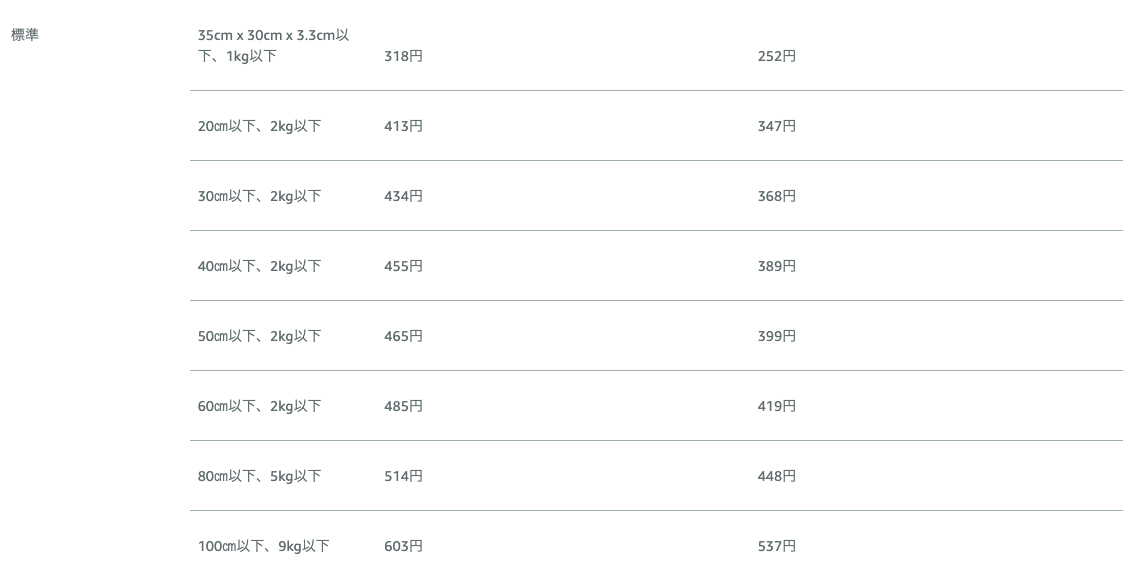
Standard sizes are divided into eight detailed categories, with a maximum dimension of 100 cm and a maximum weight of 9 kg.
The shipping agency fees vary quite a bit depending on the size, don't they?
From a cost-cutting perspective, it is also important to pay attention to product size.
Large Size
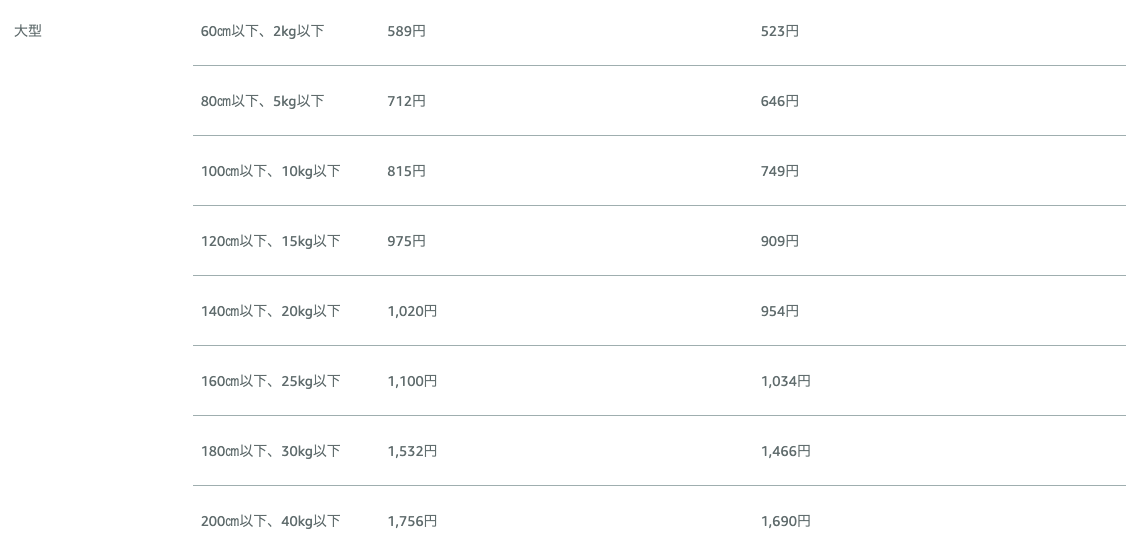
Large sizes are classified into eight categories, with a maximum dimension of 200 cm and a maximum weight of 40 kg.
The difference in shipping agency fees between Category 1 and Category 8 is quite significant for standard-size items and larger, isn't it?
Extra-Large Size
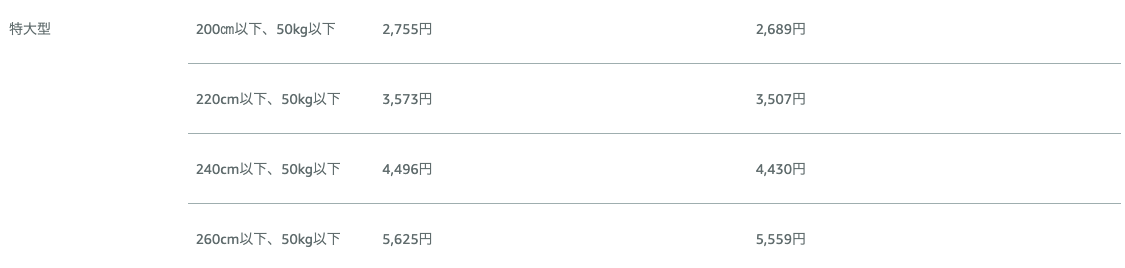
Extra-large sizes are classified into four categories, with a maximum dimension of 260 cm and a maximum weight of 50 kg.
There's a difference of about 3,000 yen in the shipping agency fee between Category 1 and Category 4, isn't there?
Shipping agency fees vary depending on the dimensions and weight of the items being shipped.
Please fill out the information accurately when making a delivery.
If you'd like to learn more, check out the link below.
https://sell.amazon.co.jp/pricing?ref_=sdjp_pricing_calc_n#cost-calculator
Inventory Storage Fee
FBA storage fees are the fees charged for storing and managing products in Amazon FBA fulfillment centers.
Average daily space usage is calculated based on category, storage period, and size.
Clothing & Fashion Accessories, Shoes & Bags
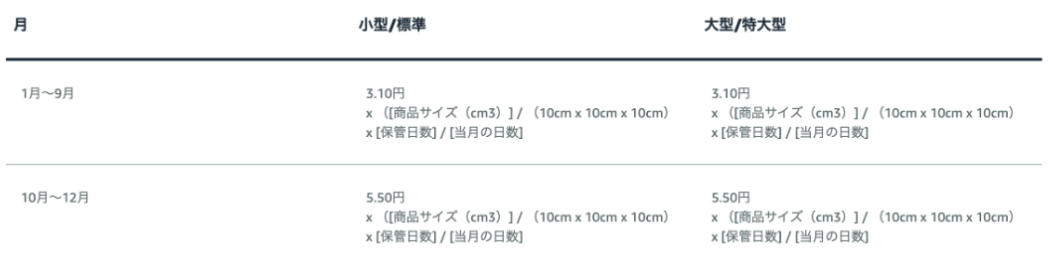
For the two categories—Clothing & Fashion Accessories and Shoes & Bags—the inventory storage fee does not vary by size. The fees are lower from January through September and higher from October through December.
Excluding clothing & fashion accessories, shoes & bags
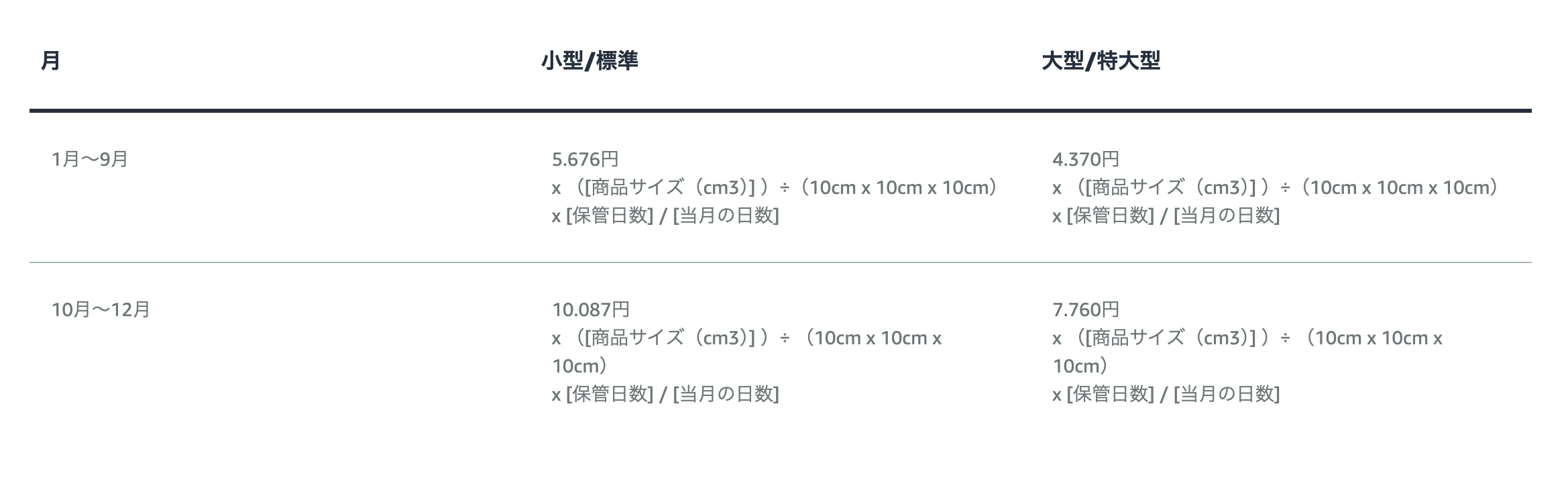
For categories other than Clothing & Fashion Accessories and Shoes & Bags, the inventory storage fee varies by size. The rates are higher from January through September and lower from October through December.
FBA storage fees aren’t that high compared to fulfillment fees, but if you store too much inventory in Amazon warehouses and leave it there, you may end up being charged a surprisingly high amount, so please be careful.
Comparison of Listing Fees on Amazon, Rakuten, and Yahoo! Shopping
Next, let's compare Amazon's fees with those of Rakuten and Yahoo! Shopping.
Since sales on Rakuten and Yahoo! fluctuate significantly due to promotional events and other factors, these figures serve as a rough guide to the typical difference between the two.
For more details, please check the listing fees for each marketplace based on the product category you want to list and the scale of your business.
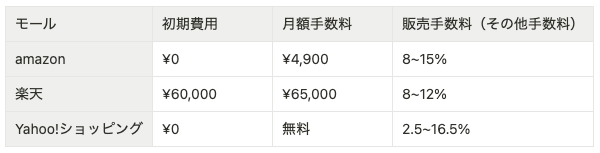
*Amazon: Fees displayed for Professional Sellers
*Rakuten: Prices shown for the Standard Plan
What do you think?
If you just compare the fees, they're completely different across the various marketplaces, aren't they?
In addition to commission fees, we recommend that you choose which marketplace to open a store on after considering other factors, such as the characteristics of the users and the categories that sell well.
Since the information above is quite general, let's take a closer look at the commission fees for Yahoo! Shopping and Rakuten.
Yahoo! Shopping Fees
A major feature of Yahoo! Shopping is that it does not charge monthly fees or sales commissions.
Since the barrier to entry is very low, one drawback is that there is a lot of competition.
Now, let's take a look at the other fees charged by Yahoo! Shopping.
Initial Cost: Free
Monthly System Usage Fee: Free
Sales Royalty: Free
Store Point Funding: 1–15% of sales (currently, 1% is required)
Campaign Funding: 1.5% of sales
Affiliate Partner Commission Rate: 1–50%
Affiliate Commission: 30% of the affiliate partner's commission fund
Deposit Cycle Fee: 0–0.4%
Fees for various payment services: 3–4.48%, 150–300 yen per transaction
There are quite a lot of varieties, aren't there?
Since Yahoo! Shopping requires you to implement various strategies to increase sales, the transaction fees can sometimes be surprisingly high.
Be sure to check your Yahoo! Shopping bills regularly.
Rakuten Fees
One thing that sets Rakuten apart from other online marketplaces is that it involves initial setup fees.
The plans are divided into three categories: “Go for It!”, “Standard,” and “Mega Shop.”
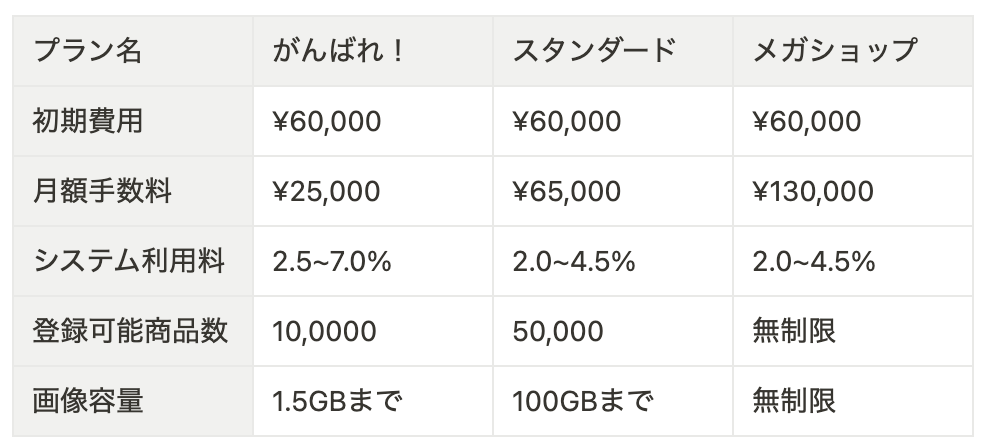
The "Go for It!" plan has low fixed costs but high variable costs.
That's why this plan is recommended for first-time sellers.
When it comes to the “Standard” and “Mega Shop” plans, I think you should base your decision on the number of products you’ll list and your image storage needs.
I’ll also list the fees that apply in addition to those mentioned above.
Rakuten Points: Typically 1.0% of the purchase price for Rakuten members
System usage fee to improve the security and convenience of transactions on the mall: 0.1% of monthly sales
Rakuten Super Affiliate: 2.6–5.21 TP3T of sales generated through affiliate links
R-Messe usage fee: 3,000–5,000 yen
Rakuten Pay Service Fees (Rakuten Ichiba Payments): 2.51 TP3T to 3.51 TP3T of monthly transaction volume
Summary
In this article, we have explained Amazon's fees and the fees charged by other marketplaces.
Since fees directly affect your profits, it’s important to check them carefully, down to the yen.
It would also be great if you could decide which online marketplaces to open a store on by considering not only Amazon but also the fees and features of other platforms, such as Rakuten and Yahoo! Shopping.
Thank you for reading to the end.



アイキャッチnew.jpg)