


Survey landing pages are increasingly being used in advertisements for a variety of products, such as cosmetics and health supplements.
In this post, I’ll explain everything about these survey landing pages—from how to create them to how to test them!
"What exactly is a survey landing page?"
"How do you create a survey?"
If you're struggling with this, you won't want to miss this!
What Is a Survey Landing Page?
A survey landing page is a type of web landing page that uses surveys to introduce products or services to users and encourage them to make a purchase.
A cushion page, as the phrase “putting a buffer in between” suggests, is a page placed between the page you want to direct users to and the source of the link, such as an advertisement.
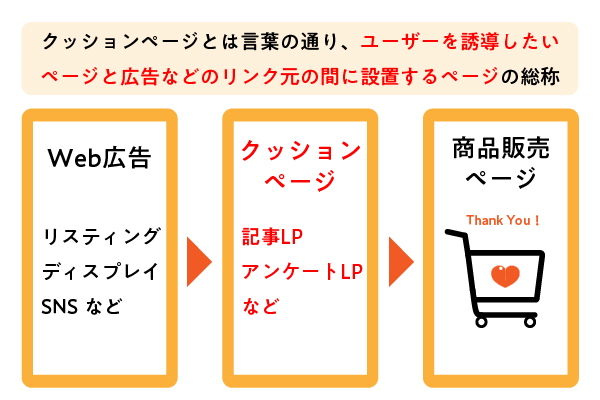
Landing pages are designed to capture the interest of potential customers who have shown even a slight interest in your product. It is common practice to use content to spark deeper interest in users and guide them to click on a link to the product sales page and make a purchase.
Features of the Survey Landing Page
A key feature of survey landing pages is that users progress through the page by answering questions. This “self-reflection” format helps bring users’ concerns to the surface and can lead to a purchase.
Another characteristic of survey landing pages is that they consist of only the bare minimum of product information and the survey itself, so they don’t feel overly “ad-like.” This allows you to guide users to the product sales page without making them feel uncomfortable.
Since many users currently have a negative perception of online advertising, a survey landing page that doesn’t come across as an ad is an effective strategy.
The Difference Between Survey Landing Pages and Article Landing Pages
Article landing pages are another example of cushion pages, just like survey landing pages.
An "article landing page"—as the name suggests—is a landing page with a structure similar to that of an article. Like a survey landing page, its purpose is to guide users to a product sales page without causing them any discomfort.
Even though they are all called "cushion pages," there are three main differences between them.
(1) User Behavior
Since article landing pages boost the desire to purchase as users read through third-party testimonials and reviews, user behavior can be described as “passive.”
On the other hand, with a survey landing page, users read through it while asking themselves which answers apply to them, which boosts their desire to purchase; therefore, their behavior is “active.”
② Regarding the time required
Generally, article landing pages are considered to be between 1,000 and 2,000 characters long, so it takes about 4 to 8 minutes to read them.
In contrast, most surveys can be completed in less than a minute.
As a result, survey landing pages have a lower bounce rate than article landing pages, allowing them to drive more users to product sales pages.
③ How Much the Product Is Promoted
One drawback of survey landing pages is that, because they are designed to be completed quickly, they do not allow for a thorough promotion of the product.
However, a product landing page can effectively promote a product to users from various angles, such as product reviews, personal experiences, and customer testimonials.
As a result, while survey landing pages are effective at driving traffic to product sales pages, the conversion rate on those product sales pages tends to be low.
| Types of LPs | User Behavior | Estimated Time | Directing Visitors to the Product Sales Page | Conversion Rate (CVR) on Product Sales Pages |
| Survey Landing Page | Passive | Short—Less than 1 minute | Many | Low |
| Article Landing Page | Active | Long—4–8 minutes | Few | Expensive |
Since survey landing pages and article landing pages—both of which are cushion pages—have different characteristics, it is necessary to determine which landing page is most appropriate for each product.
How to Create and Test a Survey Landing Page
From here on, I’ll explain everything from how to actually create a survey landing page to how to analyze the results after it goes live.
Key Points to Keep in Mind for Survey Landing Pages
The survey landing page consists of two main components: the “FV” and the “questions.” I’ll explain each of these in detail.
① About FV
On a survey landing page with limited text, it’s crucial to effectively capture users’ attention right from the first view.
On a survey landing page, users are motivated to answer questions by the “value” they perceive. By clearly communicating this value in the FV, you can encourage users to proceed to the subsequent questions. Specifically, the following elements can be cited as sources of value:
| Value-Added Features | Specific Examples |
| Price | 70% OFF, Half Price, 500 yen |
| Amount | One month's supply: 30 bags |
| Percentage | All respondents |
| Limited | LINE Exclusive: First 100 Customers Each Day |
| Convenience | Just answer 3 questions—it only takes 10 seconds to complete. |
In addition to highlighting the value, you can boost users’ motivation to answer the survey questions by including specific metrics, credibility, and benefits.
② Regarding Question Design
The key to designing test questions is,
・The questions at the beginning are easy to answer
・Gradually increase motivation to make a purchase
Those are the two points mentioned above.
I’d like to explain this using specific questions from a survey landing page that proved effective for our company.
① Are you currently taking measures to address ○○?
↓
② What concerns do you have about ○○?
↓
③ Do you know of any products developed to solve ○○?
↓
④ The following are the features of this product. Please select the ones you find appealing.
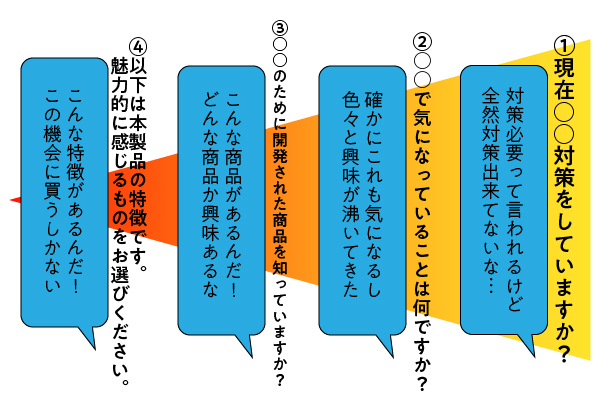
In the early stages, especially for the first question, it’s generally considered best to use “yes” or “no” answers. Since users tend to have low motivation to answer questions at the beginning, it’s important to make the questions easy to answer.
Furthermore, by designing questions that gradually bring users’ concerns to the surface starting with the first question—and then presenting the product as a solution to those concerns—you can gradually build motivation and successfully guide more users to the product sales page.
How to Test a Survey Landing Page
After the broadcast, it’s important to thoroughly analyze the survey landing page. The four main areas to focus on are as follows:
・FV
・Question Content
・Order of Questions
・Number of questions
It is relatively easier to test survey landing pages than article landing pages.
The validation methods are A/B testing and heatmaps.
① Validation through A/B testing
AB testing is a method of validation that involves simultaneously running two survey landing pages. Since survey landing pages make it easy to conduct AB tests based on the criteria mentioned earlier, this allows for simple validation.
Let's create the optimal call-to-action and question design by conducting repeated A/B tests.
② Validation Using Heat Maps
A heat map is a method of visually representing the distribution of data using color, and it is effective for evaluating effectiveness.
Since it allows you to see information such as “where users are dropping off on the landing page” and “what parts of the survey landing page users are focusing on,” it’s a useful strategy for validation.
Summary
In this post, I explained what a survey landing page is.
Since survey landing pages are easier to test than article landing pages,
Thorough verification is expected to yield significant results.
Let's conduct a thorough verification, keeping the target figures and verification criteria in mind.
Thank you for reading to the end!