


Among the various advertising methods that have emerged in recent years, search-based advertising is considered to be relatively cost-effective.
"I want to try performance-based advertising for the first time"
"I want to learn the basics of search-based advertising."
"I don't understand the difference between this and search ads."
In this article, we’ll explain “search-based ads”—a low-budget, low-risk option that allows you to run ads targeting a specific audience—for people in that situation.
What Are Search-Based Ads?
Ads that appear in Google and Yahoo search results
Search-based advertising refers to ads on Google and Yahoo, as shown in the image below,Ads displayed at the top or bottom of search resultsrefers to .
*"Shopping ads"—which display product images and prices at the top of Google search results—are also included in "search ads."
<Google>

<Yahoo!>

The area outlined in blue in the figure above, which is not a search-linked ad slot, is"Organic Search (Natural Search) Results""That said, regular websites that aren't ads will be displayed here."
By the way, improving your ranking in this organic search results section is"SEO (Search Engine Optimization)"That's it.
Part of a search ad campaign
Many people believe that “search-based ads” and “listing ads” are the same thing, butActually, “search-based ads” are just one type of paid search ad.
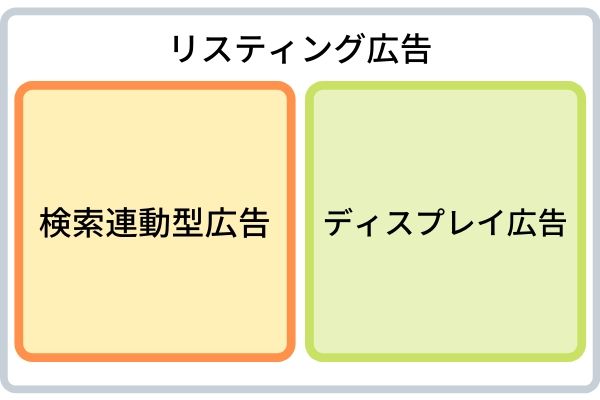
When working in the advertising industry, you often hear people say things like, “Let’s run ads on listing sites,” but since they’re usually referring to “search-based ads,” it’s easy to get confused.
To begin with, “listing ads” refer to ads that can be displayed in Google or Yahoo search results or on related websites; therefore, both search ads and display ads offered by Google and Yahoo are included in the category of listing ads.
Search ads are also known as"PPC (Pay-Per-Click) Advertising"It is also said that advertising costs are incurred when an ad is clicked.
Therefore, simply displaying an ad does not incur any advertising costs. If you consider a click to be a conversion, this is essentially a form of performance-based advertising.
The cost per click is referred to as the cost per click (CPC), and the total cost for search-based advertising is calculated as “cost per click (CPC) × number of clicks.”
Differences from Display Ads
I explained that search ads are a combination of search-based ads and display ads, but how do these two differ?
As mentioned above, search ads are “ads that can be displayed in Google and Yahoo search results and on related websites.”
Among these, search-based ads are ads that can be displayed in “search results,” whereas,Display ads refer to ads that can be displayed on "related sites" and include images.

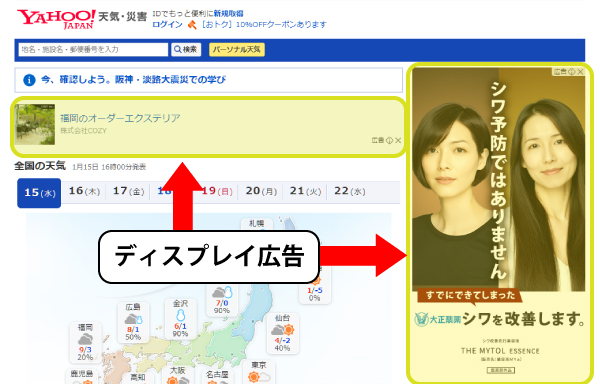
By the way, not all display ads are image ads.
You can also place "text ads"—which consist solely of text—on display ad spaces.
This article provides a more detailed explanation of display ads, so if you're interested, be sure to check it out.
In 2021, Google introduced a new feature called “Performance Max (P-MAX).”
A key feature of P-MAX is its ability to automate ad campaigns across multiple channels—including search, display, and shopping—to maximize performance.
・P-MAX's distribution channels
Google Search
Google Shopping
Google Display
YouTube
Discover
Gmail
Google Maps
Auction System Based on Cost Per Click
As the name suggests, search ads—also known as PPC (Pay Per Click) ads—incur a charge whenever an ad is clicked. But how is the cost per click calculated?
Actually, with search-based advertising,An auction is held for each keyword that multiple advertisers want to target, with advertisers bidding on the maximum cost-per-click they are willing to pay.

The outcome of this auction determines whether your ad will appear at the top of the search results page.
However, the bid amount alone does not determine whether an ad will be displayed at the top of the list.
In fact, “Ad Rank” is calculated based on two metrics—ad quality (Google and Yahoo’s proprietary criteria for evaluating ad quality) and the auction—and this determines the ad’s position.
The key point here is that simply raising the cost per click does not guarantee that your ad will appear at the top of the ad placement.
In other words, if you improve your ad rank, you’re more likely to have your ad appear at the top of the results even with a lower bid.
Especially when working with a limited budget, improving ad quality is key.
Benefits of Search-Based Advertising
You can show ads to users in the visible layer
From a marketing perspective, the target audience is divided into two groups, as shown in the figure below: the “potential audience” and the “existing audience.”
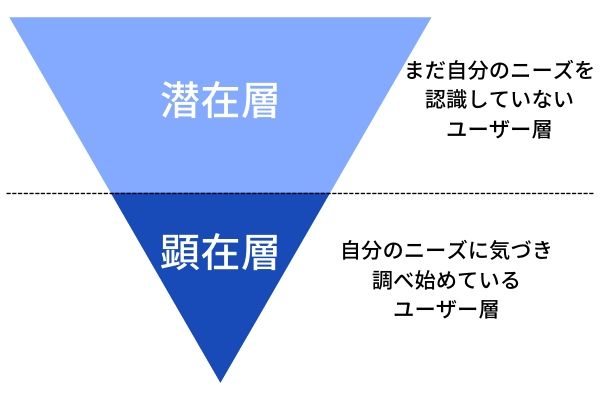
The latent segment refers to “people who have concerns or needs but are not yet aware of them,” while the explicit segment refers to “people who are aware of their concerns.”
This,The ability to effectively place ads in the visible layer is"Search-based advertising."
Since you can directly target ads at the active audience—those who are actually conducting searches—you can introduce your products to users with a high propensity to buy.
In other words, since you can run ads while avoiding potential customers who are unlikely to become actual customers, it offers a high return on investment.
You can run ads on a low budget and with low risk
Search-based ads, including search-linked ads, allow you to run ad campaigns on a relatively low budget.
The reason is thatWith search ads, you can start running ads for as little as 1 yen a day.
(Of course, I can't win a 99% auction with just 1 yen, so it's pretty much pointless, but...)
In other words, you can start by running tests on a low budget and then increase your budget as you create ads that deliver a high return on investment.
The effects are easy to measure
Search-based advertising makes it easy to analyze ads and improve their effectiveness.
For example, this image shows the Google Ads dashboard; the area circled in green contains keywords, while the area circled in red contains metrics such as “conversion count” and “cost.”
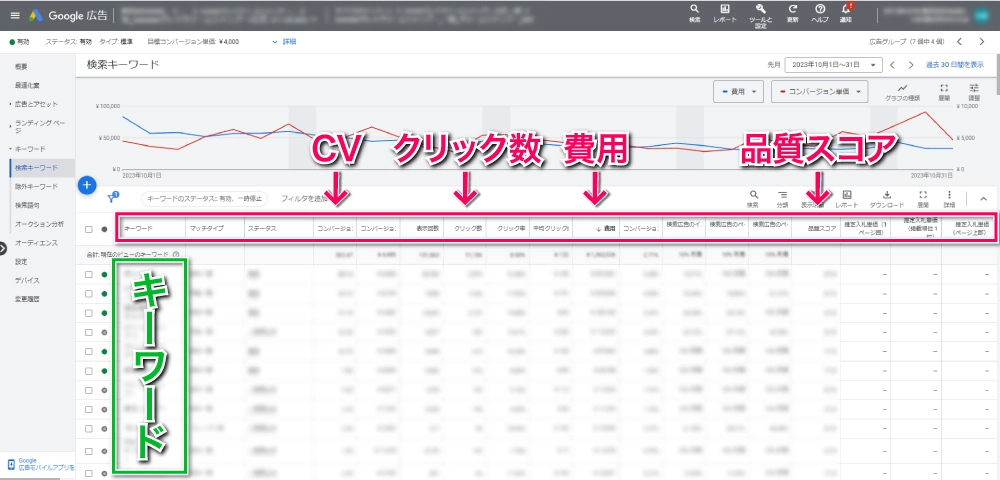
You can view the figures for each keyword, and you can also customize the displayed items to make them easier for you to manage.
Since it's easy to measure the results, A/B testing can be conducted more quickly.As a result, you can improve the return on investment for your ads more quickly.
Disadvantages of Search-Based Advertising
I can't advertise widely
Earlier, I said, “Search-based ads allow you to reach the active audience,” but conversely, this means you cannot reach the latent audience—those who are not yet aware of their own needs.
In other wordsSearch ads aren't really suited for attracting large numbers of users who might eventually become customers.
Therefore, when you want to run ads targeting potential customers to expand the market for your products or services or increase brand awareness, you need to advertise in other media.
In this case, display ads can be very helpful, so let's make use of them.
There are limits to the market size
With search-based advertising, you can place ads in the search results for keywords you bid on, but each keyword has what is known as a “monthly search volume.”
Monthly search volume refers to “the number of times a keyword is searched for in a month,” and this figure is quite important in SEO.
In other words, what I'm trying to say is that there's a limit to the search volume for the keywords you bid on.
We cannot expect more impressions (number of times displayed) than that search volume, andThere will be no further market expansion.
Therefore, to expand the market using only search-based advertising, it is necessary to increase the number of keywords.
Operating it requires knowledge and time
Search-based advertising is quite complex. It requires a certain level of knowledge, and managing it also requires time to regularly check the dashboard.
When your campaign metrics aren’t performing well, you need to identify the cause, develop a strategy, and adjust your bid prices and daily budgets in the management console, as well as carefully review the keywords you’re targeting.
To do that, you need to have a decent grasp of web marketing terminology and overcome any apprehension about working with numbers.
However, if you can overcome these challenges and successfully manage search-based ads, it’s safe to say there’s no advertising tool more powerful than this.
How to Get Started with Search-Based Advertising (Search Ads)
What you're probably wondering now is how to get started with search-based advertising, right?
Which is better, Google or Yahoo?
I think the first question that comes to mind is whether it’s better to start with Google or Yahoo.
To put it simply, let's start doing both.。
There are two reasons.
The first reason is that “while there may be differences in the admin interface and operational methods, the basic knowledge remains the same,” and the second reason is that “because there are differences in the ad placement options, we can aim to expand our market with low risk.”
Although there are some differences between Google and Yahoo users, this isn't much of an issue when it comes to search ads.
Since search-based advertising allows you to run ads with low risk and offers significant benefits, I recommend trying both.
Sign up for Google Ads or Yahoo! Ads
To get started with search-based advertising, you’ll first need to register. Create an account from the homepage below and try submitting an ad.
Summary
Do you understand the basics of search-based advertising?
To briefly summarize the characteristics of search-based advertising:"A type of paid search ad on Google and Yahoo that allows advertisers to reach a clearly defined audience with relatively low risk."That's it.
Since you can get started with a small investment, this is definitely an advertising option worth trying if your sales have plateaued and you’re unsure what to do next.
We also manage paid search ads on behalf of numerous clients.
If your sales have plateaued, or if you’d like to start running paid search ads but aren’t sure how to manage them, or if you simply don’t have the time to manage them, please feel free to contact us.