

"I want to create a product, but I don't know where to start."
A must-read for anyone who feels this way.
Here’s a brief overview of the process and key points for developing new products for single-item online retail.
Please feel free to use this as a reference.
What Is Product Development?
Product development, as the name suggests, is “the process of creating products and services.”
I think product development is sometimes considered separately from product planning, but,
For the purposes of this document, we define “product development” as encompassing all aspects of product planning.
There are two types of product development
Product development is
「Refining and Improving Existing Products and Services」
「New Product Development」
They can be divided into two types.
◎ “Refining and Improving Existing Products and Services”
Refine and improve existing products and services is also part of product development.
The theme for this session is “New Product Development,” but,
This article contains some useful insights for refining and improving your work.
◎ “New Product Development”
New product development is “Developing new products and services for the company」。
The most important thing in new product development is “creating products and services that drive sales.”
"Products and services that drive sales" refer to,
"Products and services for which there is social demand."
Not just a simple whim, but—
After conducting a thorough market analysis,We need to create products and services.
Four Steps in New Product Development
Here are the four steps involved in new product development.
This step applies not only to new product development in single-item e-commerce, but also to,
This will be helpful for the development of any new products.
Determine the Target
The target audience is sometimes referred to as a “persona.”
How to Determine Your Target Audience
When determining our target audience, we consider the following three perspectives.
① Attributes
Age, gender, family composition, occupation, educational background, place of residence, etc.
Examples: “high school boys,” “civil servants,” “people living in Fukuoka”
② Values
Things I value, my way of thinking, and so on
Examples: “Once I’ve made a decision, I see it through to the end,” “I always stay healthy.”
③ Concerns, Challenges, Dreams, and Aspirations
My current worries, challenges, dreams, and aspirations
Examples: “I haven’t been waking up feeling well lately,” “I want to become a professional baseball player.”
The Purpose of Defining a Target Audience
The primary purpose of defining a target audience is “To Conduct Effective Sales Promotions"."
By defining your target audience,
This allows us to invest our management resources exclusively in those individuals, and
Since this improves investment efficiency, you can focus your efforts on targeting the customers you want to acquire.
Pros and Cons of Narrowing Down Your Target Audience
Example: “Seniors aged 50 and older”
Now, “seniors aged 50 and older” and “older women aged 50 and older with health concerns” are,
Which of these targets can be said to be more narrowly defined?
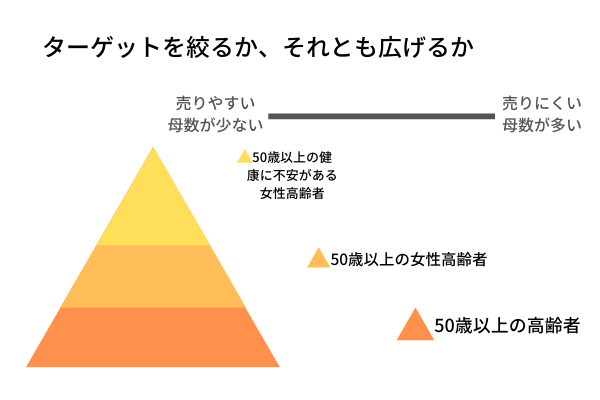
So the answer is “older women aged 50 or older who are concerned about their health,” right?
One advantage of narrowing down your target audience is that it improves investment efficiency, so
You can focus your efforts on reaching the customers you want to attract.However,
One drawback is that the target audience size decreases, so you need to be careful not to narrow it down too much.
Deciding on Products and Services
Next, we'll decide on the products and services.
How to Choose Products and Services
First, thoroughly analyze the target audience's needs.
And thenUnmet NeedsI'll find it.
"Unmet needs" refer to "needs that have not been met," and
"I want to lose weight, but I can't exercise or restrict my diet."
"I want to have beautiful skin, but I can't beat the effects of aging."
"I want to drink even better beer."
These are examples of things like “I want to,” “I’d like to,” and “I can’t.”
After identifying unmet needs,
We'll come up with product ideas that meet those needs.
What Makes a Product a Best-Seller?
Products that sell well are,
They have carefully considered a two-stage evaluation process: “before purchase” and “after purchase.”
Example: "Cleansing"
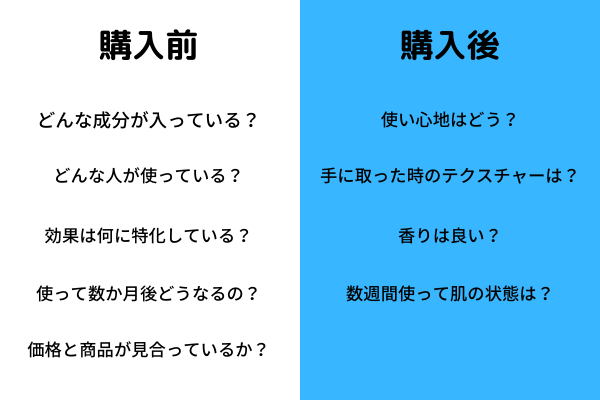
As such,
From the user's perspective, potential questions and concerns that may arise "before" and "after" a purchase,
We need to develop products that properly fill those needs in advance.
A situation where products sell well is one in which both “new customer acquisition” and “repeat business” are high, and
It can be expressed as follows.
"Number of New Customers" = "Product Concept" × "Advertising Effectiveness"
"Repeat Business" = "Product Appeal" × "CRM"
"Product concept" and "product appeal" are key elements of product development.
In other words, product development affects both “new customer acquisition” and “repeat business,” and
It is closely related to whether a product sells.
Decide on a Concept
A "concept" refers to an "idea," and
It refers to “the attitude, approach, and philosophy one adopts when tackling a task.”
When deciding on a concept, it is important to,
To put it bluntly, “Defying Conventional Wisdom"That's it."
Example: Starbucks
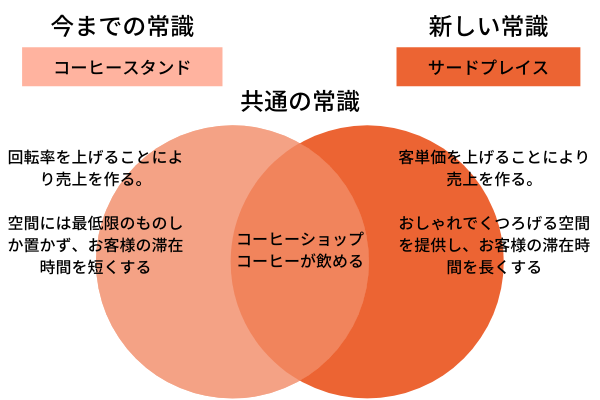
"Starbucks," the coffee shop everyone knows, is,
This is the prime example of something that defied conventional wisdom.
Originally, the concept of a coffee shop was
「Increase turnover and sell coffee"But,"
The Starbucks concept is
「Provide a comfortable space and increase average spending per customer"," and
It deviates from conventional wisdom.。
The first step in deciding on a concept is to,
「Reviewing What We've Learned So Far"That's it."
Next, we gather information to challenge conventional wisdom and decide on a concept.
4 Steps to Developing a Concept
1. Gathering Information
Information is
「Era and Society」
「Target」
「Our Products and Services」
「Competitors' products・Services」
We'll collect them from these four perspectives.
Gather information from various sources and just keep taking it all in.
Some points to keep in mind in that regard are:
Regarding information: “This information is correct,” “That information is incorrect”
Do not make such judgments.I'm open to any kind of information.
By doing so,
It gradually becomes internalized, transforming from mere information into meaningful knowledge.
2. Just Think
As I gathered information,
Always thinking, “How can I influence the target audience’s feelings?” and,
I just keep thinking, “Not like this,” “Not like that.”
3. The concept is finalized
Based on my past experience and the information I've gathered,
You'll come across things that make you think, "This is kind of nice."That's the "concept."
It’s incredibly intuitive, but I feel like, “This will really resonate with the target audience!”
The concept cannot be easily put into words.
That's because the concept is new and unfamiliar.
We know the words to describe what already exists, but,
I don't have a word that directly expresses this new concept.
However, the concept must be expressed in words.
So, one tip for expressing a concept is to use “metaphors.”
Taro Okamoto’s famous quote, “Art is an explosion,” and,
The "flying bus" concept proposed by the founder of LCC is,
At first, you might be surprised by this unfamiliar expression, but,
If you think about it for a moment, you’ll intuitively understand and say, “Oh, I see!”
This is the power of metaphor, and it is an essential technique for expressing concepts.
4. Turning the idea into a concrete product
We’ll gradually bring it to life while comparing the concept with the product imagery.
The key point here is, quite simply, “Perseverance"."
To overturn conventional wisdom and establish a new norm in society means,
It's not easy.
We need to believe in our concept and persevere in developing our products.
Launch it on the market and test it
Once we've decided on a product, we'll launch it on the market to test it.
However, it is often difficult to actually release a product to the market for testing.
In that case, test it on targets around you.
Key Points for Taking Tests
◎Be sure to test with your target audience
If decisions are made solely by product developers and staff,
I can't create anything that really resonates with users.
Make sure to,
We'll conduct monitor tests and tests on targets in our immediate surroundings.
Actual Commercialization
Finally, we'll actually bring the product to market.
However, be sure to run a simulation first.
When running a simulation,
• How much are the initial costs?
• When will the company return to profitability?
• How much will it cost?
• When will the cumulative balance turn to a surplus?
Check it.
Ways to Reduce Costs in New Product Development for Single-Item Online Retail (Cosmetics)
Even if we manage to create a product we're satisfied with when developing a new product,
If a product doesn't generate sales, then,
We are unable to continue delivering products to users.
Therefore, after calculating all variable and fixed costs associated with selling individual items online,
It will be necessary to keep costs down.
So, here are a few ways to keep costs down in single-item online retail (cosmetics).
Be sure to get quotes from at least two companies
Get quotes from at least two companies, and
By comparing options, you can keep costs down even further.
Adjust the proportions of active ingredients and marketing ingredients
When it comes to cosmetics, if you try to include every ingredient you want,
It ends up costing a lot.
Therefore, we adjusted the proportions of the active ingredients and the marketing components, and
We need to keep costs down.
The containers are manufactured overseas.
In many cases, manufacturing containers overseas leads to cost savings.
Keep product dimensions under 3 centimeters to reduce shipping costs
For Yamato Transport, the fee for Nekopos is 210 yen,
The next largest size, "Takkyubin Compact," costs 535 yen.
By keeping the item under 3 centimeters in size and sending it via Nekopos,
This makes it possible to significantly reduce shipping costs.
*As of October 30, 2020
Summary
For this article, I’ve written on the topic of “New Product Development for Single-Item E-commerce.”
When developing new products, “Things That Will Definitely Continue」「Something That's Guaranteed to Turn a Profit" is the basic premise.
Hide&seek, the company writing this blog, is a web marketing firm, and
We also assist with product development.
If you have any questions, please feel free to contact us.