

Have any of you ever heard the term “LPO”?
In this article, we’ll provide an easy-to-understand explanation of LPO, covering everything from the basic meaning of the term to specific strategies.
Please read this article to learn about LPO and use it as a reference for your future website management activities.
What is LPO, anyway?
Before learning about LPO, you first need to understand the basics of “LP.”
On a website, the first web page that appears when a user clicks a link from an online ad or a search engine (such as Google or Yahoo) is called,
A "landing page" (LP) is the first page a visitor lands on.
Broadly speaking, there are two types of LPs: “LPs in the broad sense” and “LPs in the narrow sense.”
In a broad sense, an LP refers to the first page a user visits on a website after clicking on a search result or an ad.
It might be easier to understand if you imagine the homepage or product pages of a web-based company.
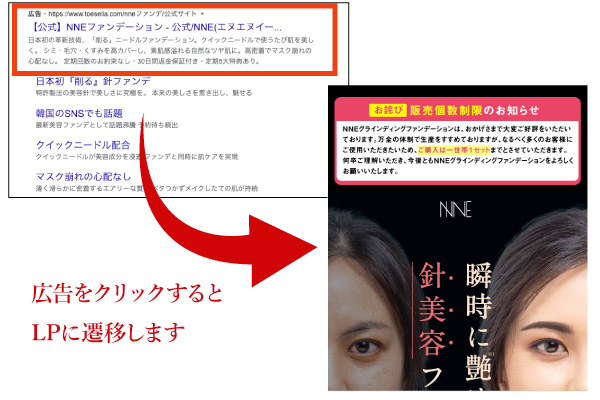
On the other hand, in the narrow sense, an LP refers to a single, vertically long page specifically designed by a company to directly drive conversions (CV), such as users requesting information or making a purchase.
Traffic primarily comes from search ads and banner ads.
Generally speaking, when people in the web marketing industry refer to an “LP,” you can safely assume they are referring to this narrow definition of an LP.
LPO (Landing Page Optimization) refers to the process of optimizing this landing page.
In other words, to increase the number of conversions (CVs)—such as service sign-ups and requests for information—
The goal is to make the LP easier to read and understand, and to improve it so that it’s more convenient for users.
However, it’s not that easy—you can’t just run ads and keep sending traffic to the same landing page and expect to get conversions.
By implementing LPO, we can make the information users are looking for easier to understand, and
We need to prevent site visitors from leaving and improve the elements that directly lead to conversions.
A Common Misunderstanding: The Difference Between SEO and EFO.
There are two terms similar to LPO: “SEO” and “EFO.”
It’s easy to get these two mixed up, so let’s make sure we understand the difference clearly.
What is SEO?
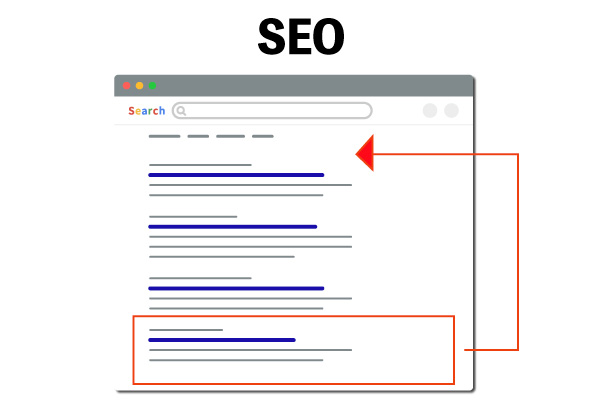
SEO stands for "Search Engine Optimization."
This refers to strategies used to ensure a website appears at the top of search results on search engines such as Google and Yahoo.
Both SEO and LPO share the common goal of generating conversions, but they take different approaches.
SEO helps create websites that are well-regarded by search engines, thereby increasing the number of visitors (page views) to the site.
On the other hand, LPO aims to improve the content of the landing page itself in order to increase the conversion rate.
In other words, by increasing page views through SEO and improving the conversion rate through LPO, you can expect to see significant results from the increase in conversions.
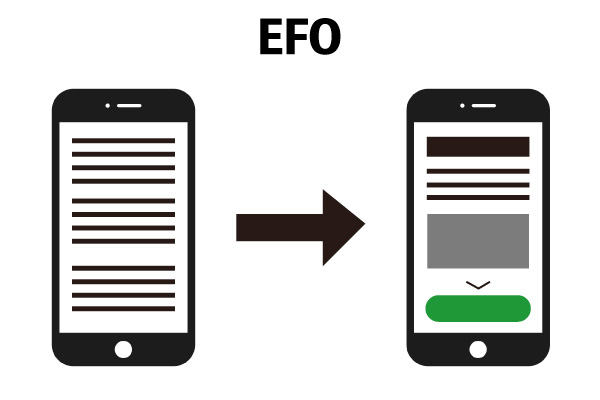
What is EFO?
EFO stands for "Entry Form Optimization," which refers to the optimization of entry forms.
An entry form is a form used when making a purchase or submitting an application.
This initiative aims to improve this form so that users can submit their applications more easily, thereby driving conversions.
Since entry forms are typically located on landing pages, LPO and EFO are often carried out simultaneously.
I think it's safe to say that EFO is included in LPO.
The LPO Process and Key Points
When actually implementing LPO, you shouldn’t just go about it haphazardly.
Furthermore, just because you implement LPO doesn't mean you'll see immediate results.
It is most effective to carry this out after thoroughly understanding the key points.
So, let’s take a look at the actual process here.
① Analyze the current situation and identify issues.
Even when actually implementing LPO, unless you have a concrete understanding of where the challenges lie and what the problems are, the implementation will not lead to effective improvements.
The key metrics to look at here are:
・Number of page views
・CVR
・CTR
・Length of stay
・Bounce Rate
・Bounce Rate
・Search keywords
I suppose these are some examples.
We will analyze these figures, formulate hypotheses, and determine what measures to take.
By conducting this analysis, you can implement a more effective LPO.
② Formulate a hypothesis regarding the issue and determine the details of the measures to be taken.
Based on the results of our analysis, we will determine specific measures tailored to address each issue.
The following are some examples of actual LPO solutions.
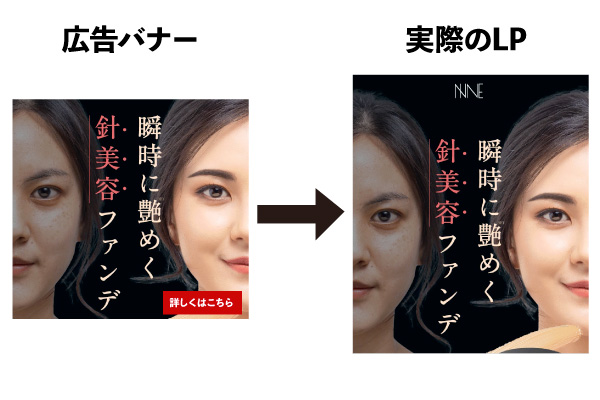
(1) The ad and the landing page’s first view are compatible.
Most users who visit an LP do so because they are interested in the content of the ad they clicked on.
But what would users think if the content on the page they actually visited was completely different from what was shown in the ad?
They might immediately leave, thinking, “This isn’t what I want to see…”
By ensuring compatibility between the ad banner that caught the user's interest and the banner on the landing page,
Users realize, “The information I’m looking for is right here!” and continue reading the landing page.
(2) Speed up page loading.
If a user clicks on an ad but the page takes too long to load and doesn't open at all, they may become frustrated and leave the site.
Actually, this might seem like a minor detail, but it’s incredibly important.
If we compare a site with a load time of 1 second to one with a load time of 3 seconds,
Some data shows that compared to a site that loads in 1 second, a site that loads in 3 seconds sees a 22% drop in page views, a 38% drop in conversion rate, and a 50% increase in bounce rate.
Source: A 2-Second Delay in Page Load Time Increases Bounce Rate by 50%! Learning Web Automation Optimization Techniques from the DeNA Case Study / Radware Japan | [Report] Web Manager Forum Meeting 2014 Spring
In web marketing, this difference in numbers is enormous.
Don't dismiss page load speed as "no big deal"—if it seems to be taking too long, we recommend taking immediate steps to improve it.
(3) Make the website mobile-friendly.
Now that smartphones are so widespread, the vast majority of users view landing pages on their smartphones rather than on PCs.
Believe it or not, as of 2024, the share of users accessing the site via PC alone is less than 10%, while those using smartphones account for over 90%!
It's probably best to assume that almost everyone is viewing it on their smartphones now.
Generally speaking, I think most people who create LPs tend to do so on a computer.
If you design a landing page to fit the specific dimensions of that computer, users viewing it may encounter line breaks in odd places or distorted images, which can make the page difficult to read and lead them to leave.
After creating the landing page, be sure to check how it actually appears on your own smartphone.
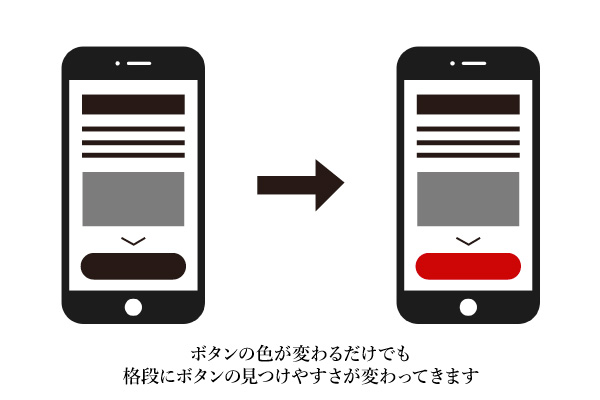
(4) Be creative with the design and placement of the buttons.
Even if a user reads the landing page and thinks, “I want to buy this product!”, if they can’t find the “Order” button right away, their desire to purchase will fade away.
The "Apply" button is a key element that leads directly to a conversion.
Since changing this element alone can make a significant difference in your conversion rate, we recommend testing multiple variations.
③ Implement improvement measures and continue the PDCA cycle based on the results.
Just because we’ve implemented improvement measures doesn’t mean the process is over.
The measures we’ve implemented may not necessarily lead to an improvement in the numbers.
In fact, it could even make things worse.
To that end, we need to review the numerical results of our initiatives and implement the PDCA cycle in detail.
A/B testing is an effective method for implementing the PDCA cycle in LPO.
A/B testing is a method in which multiple landing page variations are created to determine which one yields the greatest improvement in metrics.
Since it is possible to test multiple patterns at once under the same conditions, improvement measures can be implemented efficiently.
By the way, there’s no end to LPO.
If you keep playing the same LP for too long, users will get bored.
Continuing to implement the PDCA cycle over the medium to long term is the operational approach that ensures a steady stream of conversions.

Summary
I hope this article has helped you gain a solid understanding of the basics of LPO.
However, what is important in LPO is to continuously repeat the PDCA cycle.
Of course, LPO isn't easy.
No matter how many times you make improvements, there’s no guarantee that the results will necessarily get better.
In that case, go back to the basics, as discussed in this article, and ask yourself, “Is this landing page user-friendly?”
If we do that, wouldn't that lead to new improvement measures for the LPO?
I hope everyone's website runs smoothly!
Thank you for reading to the end!