

Hello!
I’m Sawafuji, a consultant at Hide&Seek, Inc., and I’ve worked with over 50 e-commerce companies to date!
The D2C industry has really been gaining momentum lately, hasn't it?
In the midst of all this, people are thinking, “I want to create products that sell, but I don’t know how…” or “What kind of mindset do I need to have for ‘product development’ in the first place?”
I bet there are quite a few people who are worried about this, aren't there?
In this article, I’d like to provide a detailed explanation of the key points for creating “products that sell” in the D2C space, specifically for those of you in that situation.
Our company actually operates about four online retailers specializing in health foods and cosmetics, and we have a proven track record of launching numerous hit products that generate monthly sales in the hundreds of millions of yen.
I hope the experience and know-how I gained there will serve as a helpful guide—even if just a little—for those of you who are planning to develop new products in the future!
The first half of this article covers “the philosophy and process of product development.” In the second half, we’ll explain “key points to keep in mind when developing products,” so be sure to read it carefully!
1. Product Development Philosophy and Process
Don't Be the First Penguin in the Market

Have you ever heard of the term “first penguin”?
A "first penguin" is the penguin in a flock that dives into the ocean—where natural predators may be lurking—first in search of fish.
By extension, people who possess a pioneering spirit—like this penguin—and are unafraid to take risks and try new things are called “first penguins.”
To give one example of a “first penguin,” there’s Euglena, which was the first company in the world to establish technology for the large-scale cultivation of Euglena.
Through trial and error, Euglena has created new markets for health and beauty products made from Euglena.
Of course, there are many such companies in the D2C industry, but they are few and far between. Unless a company has truly innovative proprietary technology or an idea that no one else has thought of, it’s very difficult to take the risk of creating a new market.
So what should we do?
That’s the “Don’t Be the First Penguin” strategy.
In other words, it’s about how to compete in a market that our predecessors have already created.
The fact that a market already exists means we know there is demand there.
So, when it comes to competing with rivals, the key is to..."Shift"The basic idea is to capture the market by doing this.

That said, I think there are cases where existing markets are highly competitive.
In that case, try segmenting the market even further.
For example, even if the “shampoo” market is said to be highly competitive, what about “carbonated shampoo” and “gray hair-covering shampoo”?
So, assuming that a “gray hair-covering shampoo” looks like it could be a good market fit, we should take a look at the competing products already on the market and how they’re being marketed—and figure out what changes we need to make to come out on top.
By approaching the question from the perspective of “How can we compete in an existing market?”, you’ll gradually begin to see which products will sell.
Product Development Process
Keeping the basic principles outlined above in mind, we will proceed with product development according to the following process.
① Gathering Information

We will hold discussions with organizations—such as advertising agencies—that are knowledgeable about market trends for various products to gather information on overall market trends and best-selling products.
Through this process, we’ll get a rough idea of the market segments we’ll be competing in.
② Competitor Analysis

This competitive analysis is arguably the most crucial aspect of product development.
I'll go into more detail later, but at the very least,5 companiesWe will analyze benchmark competitors from various perspectives.
③ Market Research

We will conduct a survey of general consumers.
Through our research, we will identify what kinds of people have what kinds of concerns and needs, and clarify why existing solutions are unable to address them.
④ Determine the product's features and selling points

Based on the information gathered and research conducted so far, we will determine the features that make our products stand out and the selling points to emphasize when marketing them.
⑤ Request the OEM factory to produce a sample

We send benchmark competitor products to several OEM manufacturers and ask them to use those as a basis to create products that are slightly adapted to align with the features and selling points of our own product—as determined above—in terms of user experience, ingredients, texture, and other factors.
We’ll have our personas test the finished samples, make repeated improvements, and work toward the final product.
Since the lead time for the improvement process is long, we will proceed with steps ⑥ and ⑦ below during this period.
⑥ Define the Persona and Brand Concept

Based on the findings from our market research, we will define the target persona for our company and the brand concept we want to convey to that persona.
This is also extremely important; how deeply you can delve into needs, personas, and pain points will largely determine whether your brand becomes one that is loved for the long term.
It would be great if we could decide on the product packaging design here as well.
⑦ Create a financial simulation

Create a financial simulation, andWithin 2 yearsWe will set prices and other factors with the goal of achieving a positive cash flow.
So, roughly speaking, the process goes something like this:2 to 3 monthsWe will finalize the order based on this as a guideline.
Key Points to Keep in Mind When Developing Products
First, the conclusion! A product’s success is determined by “the quality of competitor research” multiplied by “speed to market”!
To put it simply, whether or not you can create a product that sells depends on,"The Quality of Competitor Research"と"Speed to Market"...It is determined by the combination of these two factors.
It is crucial to identify the strengths that will set your company apart from the competition and enable you to sell more, as well as to bring your products to market as quickly as possible.
I will explain each element in detail.
Quality of Competitor Research
When you research your competitors, how detailed is your analysis, and from how many different perspectives do you examine them?
Since we’re competing in an existing market, improving the quality of our competitive research directly translates to sharpening the competitive edge of our new products.
That said, first of all...Key CompetitorsYou need to identify them. Benchmark competitors are those in your target market segment that are growing their customer base and are likely to become your biggest rivals once you enter the market.
Of course, in some cases you may have already identified benchmarks by gathering information from advertising agencies and other sources, but if you’re having trouble obtaining information, Amazon rankings can also be a very useful reference.
While these are only rough estimates, you can use the rankings in Amazon’s Beauty category to predict your company’s approximate number of new orders.
| Rankings | Daily Forecast of Cases |
| 500th place | 300 to 500 cases |
| 1,000th place | 200 entries |
| 3,000th place | 100 entries |
| 10,000th place | 10 to 20 items |
3 Key Points to Always Check in Competitor Research
Once the benchmarks have been established, we will finally begin the survey.
That said, there’s so much to look for when conducting D2C competitor research, so in this post, I’ll briefly introduce three key points you should definitely check.
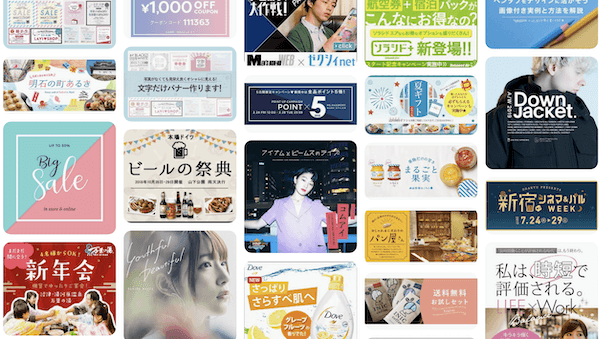
① Display Ads and Landing Pages
<ディスプレイ広告>
It’s safe to say that benchmark D2C competitors almost always run display ads as well.

②Social Media
These days, most D2C brands are utilizing social media marketing on platforms such as Instagram, TikTok, Twitter, and YouTube.
There are two main points to keep in mind when using social media.
How do you utilize influencers?

By assessing how much effort your competitors are putting into influencer-based affiliate marketing and PR, you can clarify your own company’s strategy.
If competitors aren’t doing this, we could consider adopting this strategy to increase our brand awareness and customer acquisition on social media more effectively than our competitors.
Conversely, even if competitors are already doing this, you can still find an opportunity to succeed if your own strategy and simulations indicate that you can offer influencers higher compensation than your competitors.
How many reviews are there on Instagram?

We'll check how many benchmark reviews there are, using roughly 1,000 as a rough estimate.
If there aren’t many reviews for a benchmark, you can take steps such as working with an agency to increase the number of reviews for your own company, thereby making it appear as though you have a higher profile on Instagram.
Conversely, if there are a large number of benchmark reviews, you’ll need to adjust your strategy when competing on social media.
In addition to this, there are plenty of other factors you can check—such as the number of followers on the benchmark’s official account—to identify opportunities for success, so try analyzing them with a focus on what kind of strategy your company could develop!
③CRM
It can also be effective to actually purchase a competitor’s product to see what kind of CRM strategies they’re implementing.
Since CRM is a strategy for improving LTV, if you can use CRM to set yourself apart from the competition, your LTV will increase accordingly, allowing you to set a higher acceptable CPA than your competitors.
By setting a higher CPA than competitors, you can improve engagement with affiliate networks and make it easier to collaborate with influencers, thereby expanding the range of new initiatives—which directly translates into a competitive advantage for your company.
There are countless aspects to consider when it comes to CRM.
For example, there are various aspects to consider, such as the level of detail in the packaging of included items, strategies for upgrading orders to bundled shipping, how to write email newsletters and the content of automated email sequences, how to utilize the official LINE account, and the scripts and response methods used by the call center to prevent cancellations.
To give one example, a company that sells foundation took a cue from another company in a different industry—which had improved its customer retention rate by including small accessories to be used with its main product in shipments—and successfully improved its own retention rate by including a makeup puff in its packages.
This alone serves as a key differentiator from competitors. Furthermore, by leveraging its proprietary expertise in managing LINE, the company focuses on customer retention and cross-selling, and incorporates skin analysis—initiatives that competitors do not typically undertake—to increase LTV.
In the CRM field as well, we look for ways to gain a competitive edge by comparing our company’s strengths and the success stories of other companies against our competitors as benchmarks.
I’ve introduced three basic points to check during a competitive analysis, but these are intended solely to highlight the key selling points of the new product you’re planning to develop and to clarify the direction of its marketing strategy.
We determine the factors necessary for developing new products—such as price and ingredients—by selecting at least four other online retailers that sell similar products and researching and comparing each one.
Speed to Market

Market trends in the D2C sector change very rapidly.
So, even if you spend two years preparing everything we’ve discussed so far and are finally ready to launch, it’s entirely possible that by the time you do, the market will have disappeared...
As a general guideline, once you start product development,Within one yearI really hope we can get it to the point where we can start selling it.
To maintain this pace, it’s not just product development that matters—the “operational capabilities” of the entire e-commerce business are key.
In other words, with D2C, it’s not as simple as “once you’ve made the product, all you have to do is sell it!”—
What about the shopping cart, checkout, printing, packaging, logistics, shipping, and the call center? What about the landing page? What about ad management? There are quite a few things you need to prepare before you can start selling.
For example, it’s too late to say, “Let’s order the products from the OEM and set up the shopping cart system after they’re delivered!” or “Let’s consult with the agency once the landing page is delivered!”
How much time and effort does each task require, and which tasks must be completed first before we can start on others?
So, how can we build these “sales systems” as quickly as possible, and how can we get started as fast as possible before our competitors launch their products?
This “sense of speed” and the “handling capabilities” that make it possible are also crucial elements in creating products that sell well through D2C.
Summary
The “How to Create Best-Selling Products” approach I’ve explained so far is, after all, just one strategy among many at this point in time. It’s entirely possible that it will become obsolete as times change, and even now, it’s entirely possible to create hit products using strategies other than this one.
However, no matter what era we’re in or what strategy we adopt, one thing that remains consistently important is to constantly gather information.
What kinds of products are selling right now, and how? What are the market trends? What are some success stories in other genres? It’s best to keep gathering information on these topics at all times.
I hope the information in this post will provide you with some insights into how to achieve your goals.